|
 How to review Beckett? There's a question – which begs another: why is there an issue with this? For me, at least, the answer is that Beckett arrives with baggage, a reputation – he's regarded as a pioneer, the playwright who confronts us with drama stripped down to its essentials, loading the responsibility for interpretation onto his audiences and critics. How to review Beckett? There's a question – which begs another: why is there an issue with this? For me, at least, the answer is that Beckett arrives with baggage, a reputation – he's regarded as a pioneer, the playwright who confronts us with drama stripped down to its essentials, loading the responsibility for interpretation onto his audiences and critics.
I have seen Godot a couple of times, Endgame (with Robert Pennant Jones as Nagg); and Happy Days (superb Ruth Sullivan) and Krapp's Last Tape (ditto John Chapman), both directed by him. I wondered: what if I were to eschew the business of searching the Web, finding out what I “should” think, setting Play and All That Fall in their context in history and in Beckett's oeuvre? I arrived at the Tower on opening night to a healthy first-night audience – including significant numbers of the Beckett Society (and Sir Ian McKellen) - with as open a mind as I could manage, and at the time of writing have yet to read my complimentary programme.
 The main stated purpose of Tower reviews is for the information of Members, and specifically not for the public. So here goes – a few paragraphs giving just my impressions as an uninformed punter – concentrating on the impact and technical qualities as I experienced them, and reviewing the performances rather than the text. Afterwards I shall do a bit of “reading around the subject” and possibly revise my opinions correspondingly. The main stated purpose of Tower reviews is for the information of Members, and specifically not for the public. So here goes – a few paragraphs giving just my impressions as an uninformed punter – concentrating on the impact and technical qualities as I experienced them, and reviewing the performances rather than the text. Afterwards I shall do a bit of “reading around the subject” and possibly revise my opinions correspondingly.
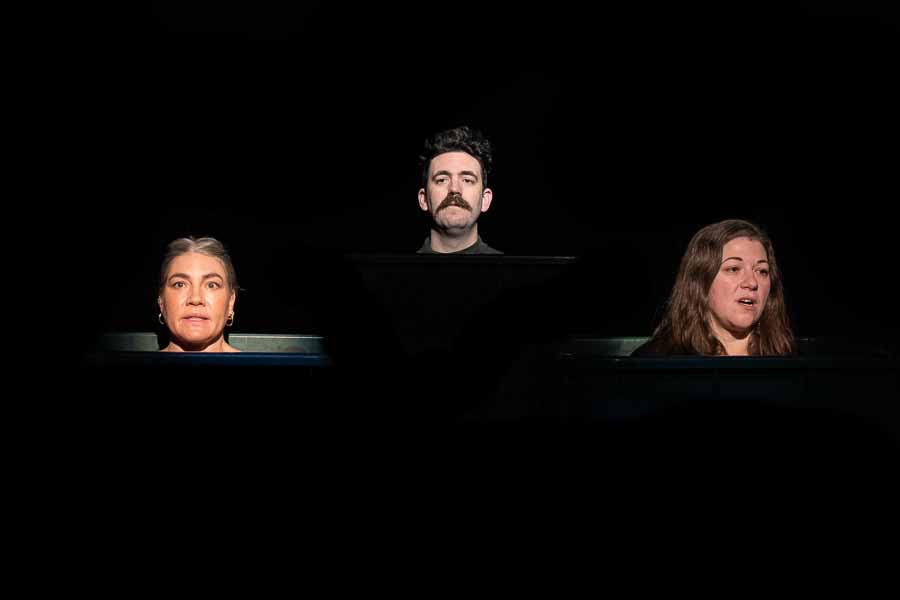
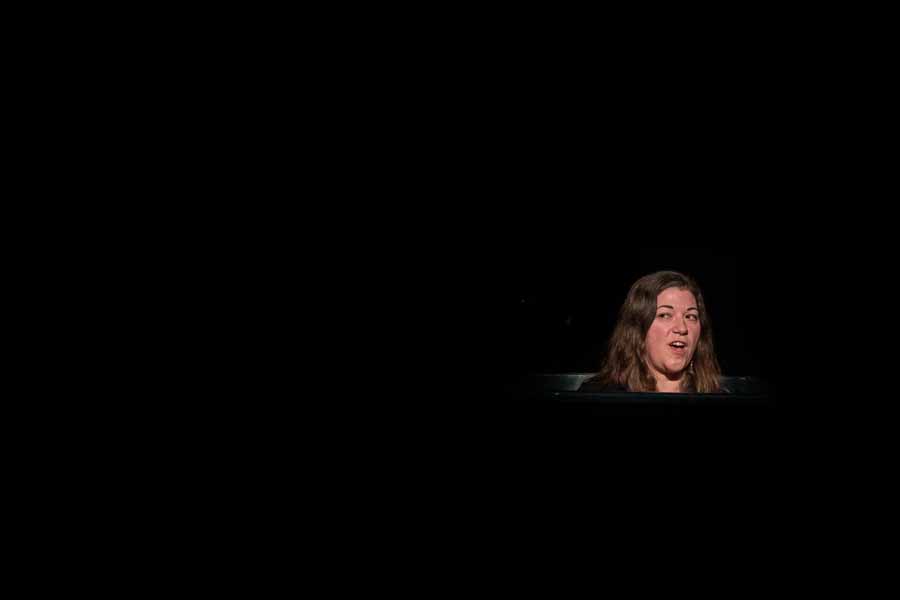
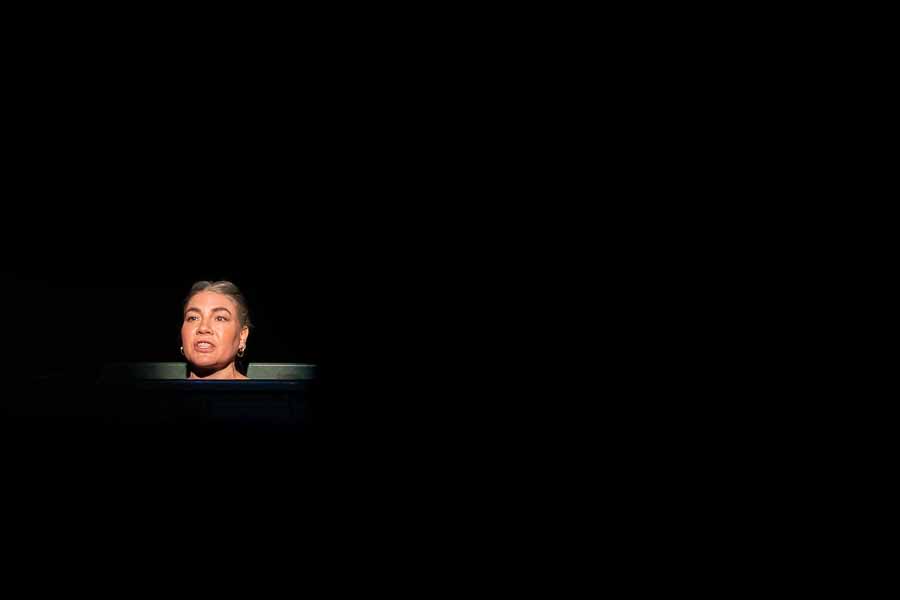
Arranged on a heap of earth/rock, centre stage, we find three tapered bins with, protruding from each, the neck and head of an actor – a man upstage and two women nearer and slightly lower – Set Design by Isaac Insley. As the lights go down, they raise their heads and begin (always lit when talking, dark when not): simultaneous snippets of dialogue which one tries to disentangle. Gradually these passages lengthen and become more comprehensible – we can detect discord, and evidence of an Eternal Triangle. After a bit each actor has the chance to give us whole sentences and more of a sense of his/her rôle in the story. I was impressed from the beginning with the actors' accuracy and rhythm: there seemed to be a background beat to the delivery when two or three spoke together. No space was given for fresh thoughts or pauses – the pace was relentless. Particular mention must go to Kate Roche (Assistant Director) for operating three individual spotlights with impressive accuracy – clearly to be regarded as a fourth performer (Beckett's intentions, as I was later informed, were that this 'Interrogator' should be using light to compel speech).
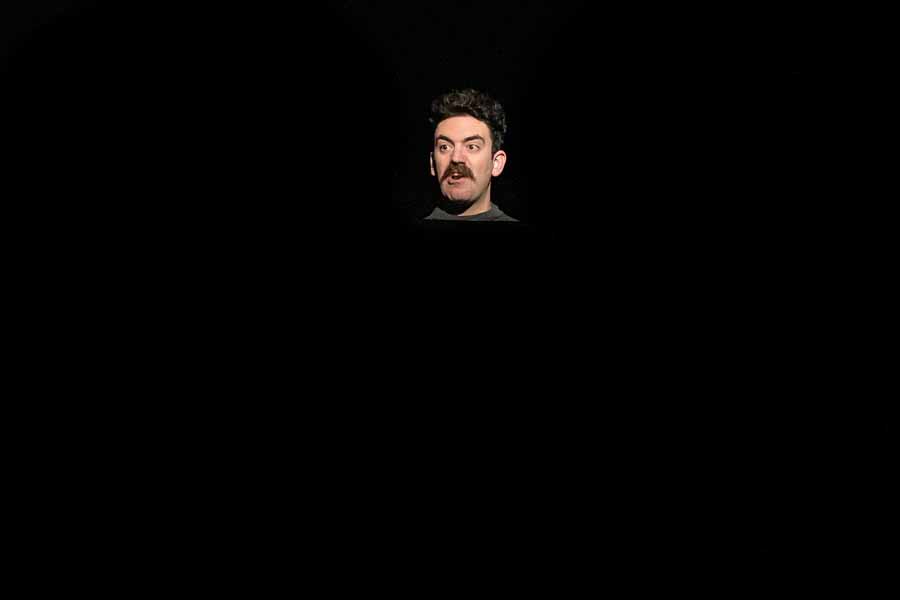 As to plot, the extracts of repeated dialogue and narration are ample for the first-time listener to piece together an everyday tale of infidelity – the man curiously not coming in for any implied criticism, the women managing their emotions calmly and acceptingly. One gathered that the married couple were eventually reconciled (Julia Blyth as W1), the Other Woman (Lucy Moss as W2) remarkably sanguine at the end of her involvement. Beckett's aim with the staging, I imagined, was to force the concentration of the audience on faces (although no wild extremes of emotion were on show); and on the text, as if it were being recalled some years after the events referred to. There must have been a few others besides me in the audience for whom James Johnston's face was partially obscured by one of the women. I don't know how precisely prescriptive Beckett's instructions are, but in this arrangement a greater height difference would have helped. A precision performance all round, clear diction and, on the surface at least, a very clear account of the events – unhampered by the types of background history and 'back-story' padding that many another playwright might have thought desirable. As to plot, the extracts of repeated dialogue and narration are ample for the first-time listener to piece together an everyday tale of infidelity – the man curiously not coming in for any implied criticism, the women managing their emotions calmly and acceptingly. One gathered that the married couple were eventually reconciled (Julia Blyth as W1), the Other Woman (Lucy Moss as W2) remarkably sanguine at the end of her involvement. Beckett's aim with the staging, I imagined, was to force the concentration of the audience on faces (although no wild extremes of emotion were on show); and on the text, as if it were being recalled some years after the events referred to. There must have been a few others besides me in the audience for whom James Johnston's face was partially obscured by one of the women. I don't know how precisely prescriptive Beckett's instructions are, but in this arrangement a greater height difference would have helped. A precision performance all round, clear diction and, on the surface at least, a very clear account of the events – unhampered by the types of background history and 'back-story' padding that many another playwright might have thought desirable.
During the interval the bins were removed, leaving a feeling of landscape, eked out by lighting on the back curtain (Lighting Designer Stephen Ley). I had presumed (wrongly) that for this 'radio presentation' (again a stipulation of Beckett's estate?) we were to watch actors performing in front of us from scripts. Instead of this, there was a very plausible gathering of the cast from the front seats of the audience, a few hugs, and all trooped off to the dressing room. A nice touch of humanisation, I thought.
 Through an inadvertent snippet of information, I gathered (after the performance) that the BBC Radiophonic Workshop owes its foundation in part to the considerable requirements of recorded sound in All That Fall. These were expertly chosen and operated (Laurence Tuerk) and provided a few moments of amusement, particularly when one character referred to all the sounds one couldn't hear, and each was trotted out as soon as mentioned! Through an inadvertent snippet of information, I gathered (after the performance) that the BBC Radiophonic Workshop owes its foundation in part to the considerable requirements of recorded sound in All That Fall. These were expertly chosen and operated (Laurence Tuerk) and provided a few moments of amusement, particularly when one character referred to all the sounds one couldn't hear, and each was trotted out as soon as mentioned!
Again, at the 'surface level' at which I absorbed the experience, I found the play to be a simple narration of rural Irish life, concerning the journey of a wife of many years towards the railway station where she was to greet her husband from the train. The incidentals were realistic-sounding exchanges between local characters about their families – usually along the lines of 'could be better, but not too bad'. I couldn't be sure that a point was being made about the low expectations of the Irish characters, or possibly their uncomplaining normalness. No-one seemed cheery or positive, nor with any plot-worthy contribution to make. As an exercise in technical competence, one was easily able to imagine a relaxing afternoon listening to the Home Service – indeed I suppose it's possible that that was where it was first heard unless, as Literature, it would have featured on the Third Programme...
 The performances were first-rate – with Linda Shannon taking the lioness' share as Mrs Rooney for the first half. Many skilful contributions were made from actors with 'bit-parts' throughout: Alan Maddrell, Bob Hough, Kevin Furness, Tom Tillery and Emma Cornford. The ensemble gave a very complete sense of being somewhere unfamiliar but quite well-defined. Several lines spoken by a young boy were very convincingly delivered by one of the women (I presume). Eventually John Chapman took over the reins, as it were, as Mr Rooney. It turned out that his delayed arrival, which had been noted with puzzlement by other characters, had been caused by a child falling from the train and under the wheels. That this dreadful accident should have caused no more than 20 minutes' delay was possibly the most jolting point to be taken from the whole play - whose title, we were reminded, forms part of a psalm asking for God's protection. The performances were first-rate – with Linda Shannon taking the lioness' share as Mrs Rooney for the first half. Many skilful contributions were made from actors with 'bit-parts' throughout: Alan Maddrell, Bob Hough, Kevin Furness, Tom Tillery and Emma Cornford. The ensemble gave a very complete sense of being somewhere unfamiliar but quite well-defined. Several lines spoken by a young boy were very convincingly delivered by one of the women (I presume). Eventually John Chapman took over the reins, as it were, as Mr Rooney. It turned out that his delayed arrival, which had been noted with puzzlement by other characters, had been caused by a child falling from the train and under the wheels. That this dreadful accident should have caused no more than 20 minutes' delay was possibly the most jolting point to be taken from the whole play - whose title, we were reminded, forms part of a psalm asking for God's protection.
Now I have looked at the programme, which contains a very good history and background from Robert Pennant Jones This includes reference to his having directed the one-act trilogy almost exactly 50 years ago in June 1973, staging All That Fall (with permission from Beckett) as a radio play backstage (or pre-recorded, according to the Tower Archive). Amongst the cast then was Tom Tillery (again in the part of Mr Barrell), and Laurence Tuerk made the sound recording! Amongst 'other voices' in this production is credited one Owen Jones as, curiously, also 50 years ago... Just a guess, but I suppose the recording made then was revisited for his contribution, which was seamlessly and undetectably spliced in for this production. So not one of the women, then! Pennant Jones also mentions “Beckett's growing emphasis on the importance of words....” - which, I suppose is the obvious thing one comes to realise.
 And now, what does the InterWeb have to add? I was pleased to learn that Play contains markings that one would expect to find in a musical score concerning tempo, volume and tone – I certainly appreciated the expert ensemble performance that resulted, in the same way one would enjoy a string trio. Although there would seem to be some slight parallel with Beckett's own relationships, there does not seem to be much enthusiasm for mapping them precisely on to Play. Other interpretations (spotlight as God, characters in Purgatory, etc.) belong, I think, to each person's own preferences – in short, I don't feel my wilful unpreparedness did me any harm. And now, what does the InterWeb have to add? I was pleased to learn that Play contains markings that one would expect to find in a musical score concerning tempo, volume and tone – I certainly appreciated the expert ensemble performance that resulted, in the same way one would enjoy a string trio. Although there would seem to be some slight parallel with Beckett's own relationships, there does not seem to be much enthusiasm for mapping them precisely on to Play. Other interpretations (spotlight as God, characters in Purgatory, etc.) belong, I think, to each person's own preferences – in short, I don't feel my wilful unpreparedness did me any harm.
All That Fall was written as the result of a request from the BBC (not a commission). I was right about the Third Programme! And the Radiophonic Workshop emerged from the requirement to make the sound effects less than purely realistic through manipulating the already available recordings. Beckett (and now the Beckett estate) have staunchly refused to allow live stagings, although several attempts have pushed the boundaries – including one recent one that required the audience to wear blindfolds.
I seemed to have 'missed' a few salient points in this production – through my own fault, not Beckett's or Pennant Jones' – such as Mr Rooney's blindness (how did I miss that?); and the pervading references to death in a number of guises: the hen; the car engine; the Death And The Maiden quartet being played; the child under the train (did the evasive Mr Rooney have something to do with that?); various seagoing disasters. And (apparently) sex in various senses, chiefly centred around Mrs Rooney, the shoving of her into the limousine and subsequent extraction therefrom.
 The point I think is that one can make lists of such topics in very many pieces of literature to satisfy one's need for themes but, as Eileen Atkins suggested 11 years ago in a Guardian interview, it's unwise for actors to overdo the analysis: “If academics want to discuss it, that's fine; but it's not very productive for an actor. You just have to have a feel for the text, the words, the poetry. [...] I think it's for the audience to decide. People should go away into restaurants afterwards and discuss what it was about. I have a story in my head, and my story of telling this is as valid as anybody else's." The point I think is that one can make lists of such topics in very many pieces of literature to satisfy one's need for themes but, as Eileen Atkins suggested 11 years ago in a Guardian interview, it's unwise for actors to overdo the analysis: “If academics want to discuss it, that's fine; but it's not very productive for an actor. You just have to have a feel for the text, the words, the poetry. [...] I think it's for the audience to decide. People should go away into restaurants afterwards and discuss what it was about. I have a story in my head, and my story of telling this is as valid as anybody else's."
The author of the Wikipedia article says: "All That Fall manages to develop a highly dynamic genre in radio drama through a multi-layered script, which can be read as tragicomedy, a murder mystery, a cryptic literary riddle or a quasi-musical score."
Take your pick!
Photography by David Sprecher
|