|
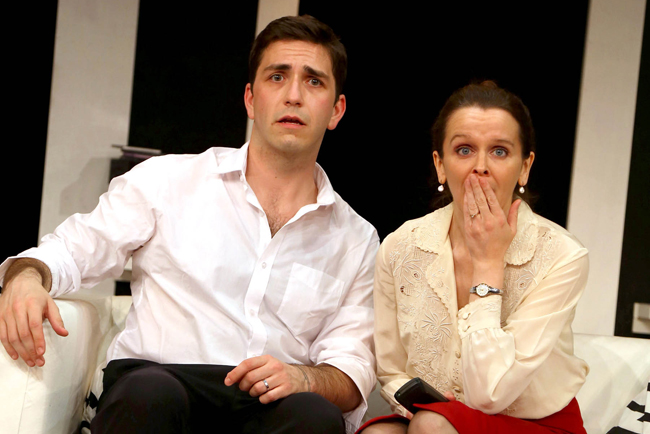 We enter to a striking set by Phillip Ley - black and white with a few touches of red, smart furniture, drinks, stereo stack, reflecting the values of the well-to-do professional couple who live here - flanked by large photos of mid-20th-century British comedy greats (Tony Hancock chosen, perhaps, as one of many deeply dissatisfied comics - maybe a prevalent occupational hazard ...). The regular welcoming Tower announcement cracks an unaccustomed joke as an encouragement to laugh at what we are about to watch. For my part, I was chuckling along with the amateurishly parroted sketches at one point, but I found that laughter at the relationships of the couples themselves was harder to come by. I have seen accounts of the impact of this play which suggest farce and hilarity - personally I reacted more to the characters' grimness and discomfort.
The script anchors us firmly in 1992, in the April week in which Benny Hill and Frankie Howerd died within a couple of days. This makes Dead Funny really a period piece and so has the curious effect of reminding us what the British attitude to humour was then, and how greatly it has changed since. The nerdish concept of a 'Dead Comics Society' seems less plausible these days than it was nearly 30 years ago - maybe as a result of greater cynicism, and less faith in the idea of universally worshipped comedians.
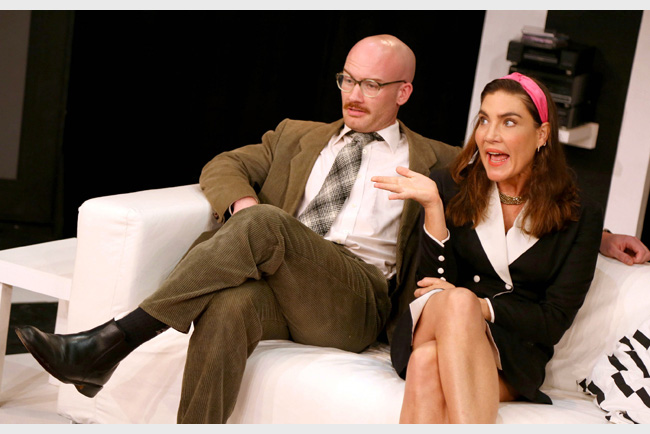 We soon take this prerequisite Zeitgeist on board however, once we hear what the Society members have to say - but Johnson makes us wait for that : first we are plunged into the very unhappy relationship between Eleanor, a part-time college lecturer, and her consultant gynaecologist husband Richard. Richard's drunken triumph at securing tickets for a Norman Wisdom show is trodden underfoot in the bitter marital battle. We catch the mood quickly -between Eleanor's acid wisecracks and cynical asides and Richard's evasive and prickly excuses. It's Wednesday evening when (as he well knows) they must regularly try to do something to rescue the physical part of their relationship. Eleanor refers several times to her last birthday (late 30s), and by implication her biological clock. Her self-awareness and active sense of humour (as a determined non-member of the Society) are pointedly lacking in most of the other characters. Helen McGill looked and sounded the part perfectly. She found effective uses for a repertoire of reaction faces, seen by us but not the other characters, expressing general exasperation and a low expectation of making real contact about Life Matters. Poignancy and hurt were well conveyed at appropriate moments - at one point she confesses to suckling the baby she is looking after, desperate to experience a touch of motherhood. Johnson here sets up a gentle puzzle in our minds - why does Richard not respond; what is his problem?
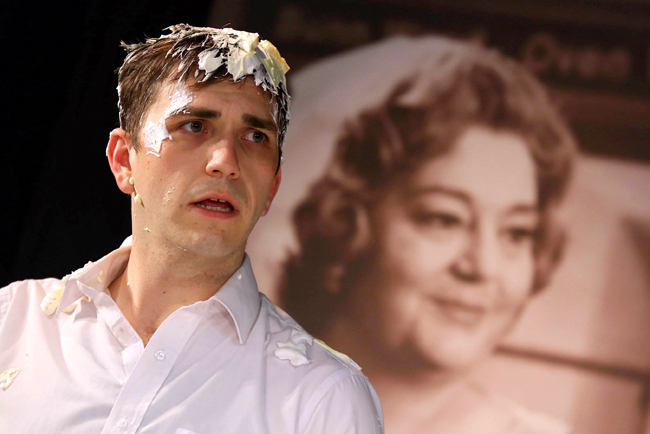
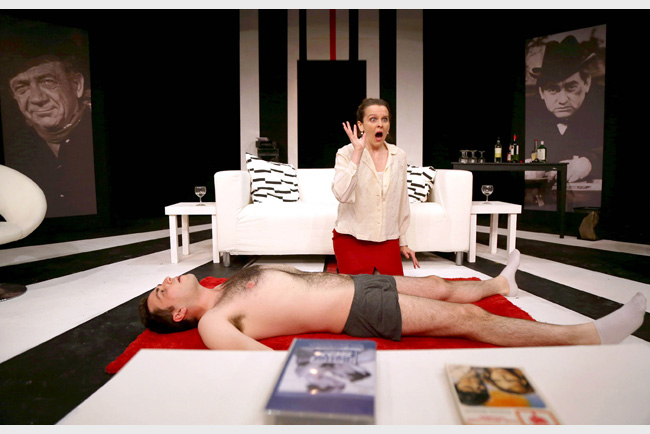 Richard pleads a tiring day and general disinclination. At some point he makes the familiar (and conventionally female) statement of limits : "It's my body!". Ryan Williams skilfully kept his cards close to his chest in a way that succeeded in arousing my puzzlement at and sympathy for his condition, rather than reminding me of what's actually going on in his private life (to be discovered later).
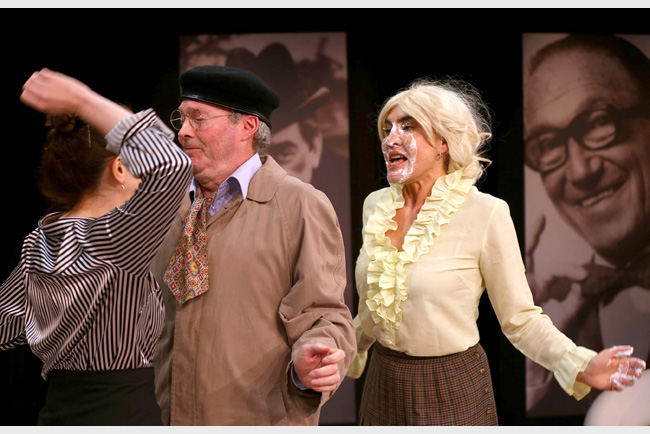
Top marks here to Diane Carr for costume design - appropriate professional-class smart outfits slotting four of the characters into their era and career paths, and contrasting sleeveless jumper and nondescript trousers for Brian. Later, accurately ludicrous dressing-up items appeared when the tribute party requires Benny Hill impersonations at some level - complete with amateurishly crammed-on wigs. As a bonus, Diane's voice was quickly recognisable on the 'sex tape' - as was that of Peta Barker ...
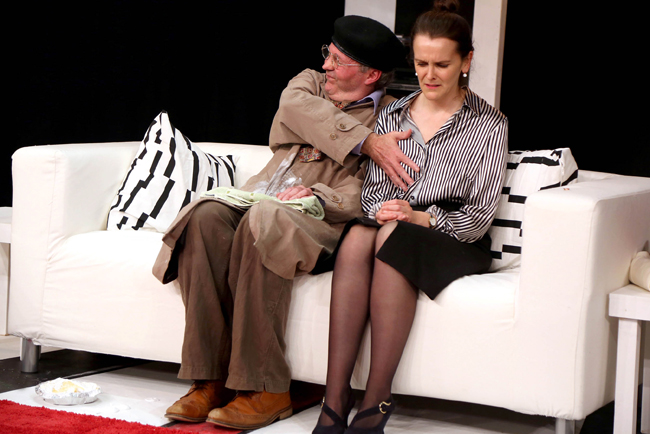 When Eleanor and Richard's awkward attempts to follow their sex therapist's instructions are comically interrupted, some of our generosity towards Richard evaporates. The doorbell-ringer is their neighbour Brian, all of a flutter to reveal the shocking news that one of their comedy heroes, Benny Hill, has just been found dead. Here we encounter full blast the other theme of the play : the deadening seriousness of (mostly) men clinging on to safe comic territory in the rapidly receding past, at the cost of their own sense of humour - which supplies us with, if not actually belly-laughs, then wry grins of recognition at obsessive types everywhere. Daniel Watson as Brian convincingly trod the narrow path between in-your-face high camp and introspective mother's boy, and persuaded me that his was easily the most sympathetic character on display. In his first conversation with Richard we discover their men-as-boys world, perhaps unsurprising in Brian, but more of a shock with Richard.
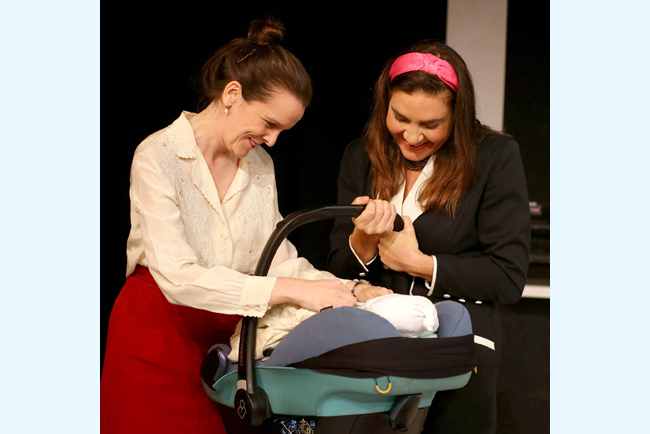
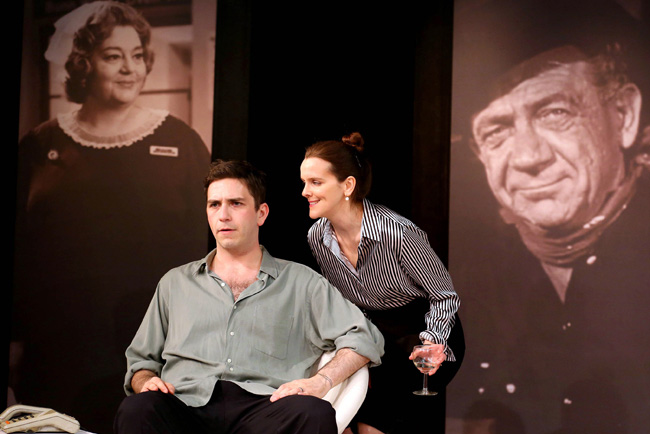 Richard agrees to host a memorial evening for Benny Hill, provocatively choosing next Wednesday (to Eleanor's evident irritation), and begins to 'phone round the other members of the Society. Firmly ushering Brian from the house, Eleanor enjoys the play's one close scene with Richard while they goggle at the demonstration of a real couple 'doing it' on their therapeutic video - only to be interrupted once more by the arrival of their friends Lisa and Nick, whose very young baby they have been looking after during the evening. There is some unspoken pain in this couple, too - manifesting itself with over-hearty joke-making and wifely insults on the part of Nick, and claims of mild clairvoyance on the part of Lisa. Lucy Moss, as Lisa, was full of her spurious connection to 'showbiz' and her allegedly prescient headaches when noteworthy events are taking place. Her awkward positioning as the only woman in the Society, and her stumbling attempts to cover her one fatal slip of the tongue, were very well conveyed - comic to the well-informed audience but clearly agony to her character. Her version of the men's obsession is diverted to her baby, her recitation of all the usual alimentary details twisting the knife for Eleanor who is desperate to become a mother.
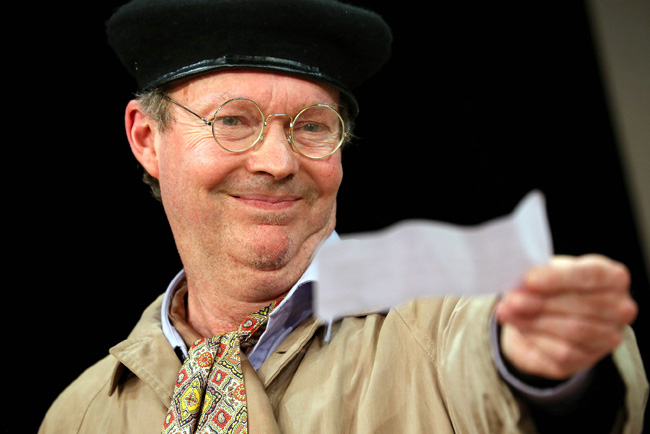 James van Langenberg made a very good job of probably the hardest role - Nick comes across as a rather shallow and wisecracking friend of Richard, letting slip little by little his disregard for his wife, and making us wonder what makes him tick. We are well into the play before his 'moment' arrives - the one when he confides to Richard that two separate fertility tests make it impossible that 'their' baby is in fact his. His understandably bitter tone here explains his over-jocular public persona. Dramatic irony for us, because we have by then seen Richard thrusting eagerly at Lisa, apparently not for the first time, in the 'whoops!' moment at the interval curtain, when they are discovered in flagrante by Brian. But, of course, (more irony) Nick doesn't know about this affair for a while, until Lisa's slip of the tongue and Eleanor's scalpel-like resulting cross-examination.
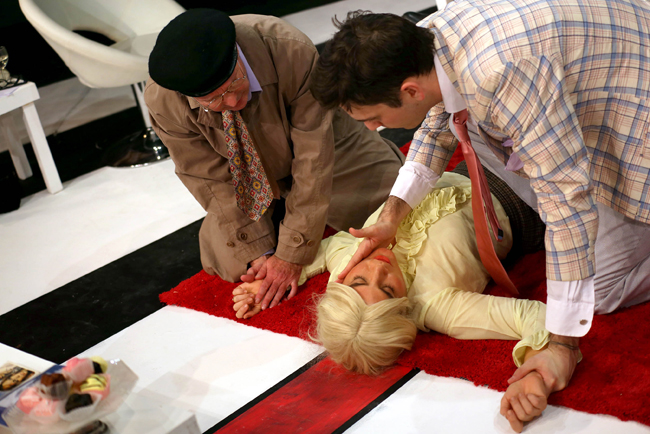 There is a diversion from their own woes when Brian bravely reveals that he is gay (along with Benny and Frankie - surprise!), evoking Richard and Eleanor's support but Lisa's disbelief (cue for more marital argument). We feel that Brian may be the only character to 'make a journey' in this play. His actual booked exploratory real journey to Amsterdam he eventually rejects (to our disappointment), providing the only small resolution in a final scene with Eleanor. These two have more capability for adjustment and acceptance : "You've got to laugh", they tell us at the end. For others in the cast, things are left unresolved - the paternity of the baby; the chances of reconciliation for Eleanor and Richard (she still loves him despite everything, but he's prepared to move out); the destruction of Lisa and Nick's relationship.
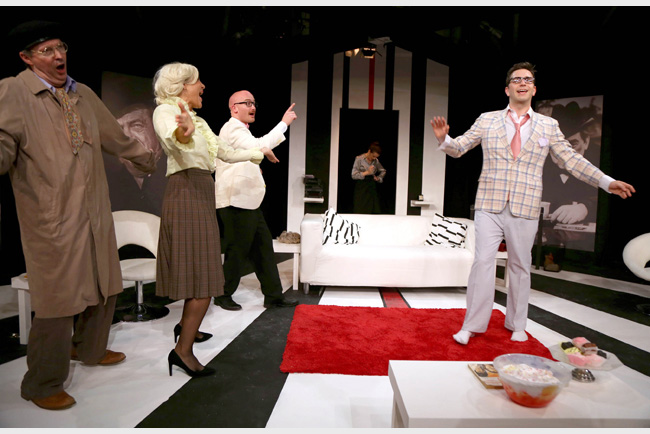 Allan Stronach's direction was always strong and the characters were played for truth - my only comment would be to suggest that interpolated sketches and 'funny moments' could have been more obviously manic and overplayed, as in the speeded-up Benny Hill sequences of old, but I accept that huge and sudden variations in pace are notoriously hard to do. The level of ineptitude in the Benny Hill impersonation party was very well contrived - performances intended for their own mutual approval and consolation, and nowhere near good enough for a paying audience. The increasingly downbeat ending, with its unresolved loose ends, required (and got) a steady hand on the brakes.
Sound (Stephen Ley - incorporating familiar Hill themes) and lighting (Robert Irvine) were clear and unfussy, and expertly delivered by Danya Bradley-Barnes and Emily Carmichael. Stage management was invisibly in the hands of Laura Humphreys.
Deliberately made ambiguous by Terry Johnson, and precisely played by the excellent cast, this play asks more questions than it answers about humour, evasion, dysfunction.
Funny is dead; the dead are(n't) funny; funny can be analysed to death; funny how relationships die, etc ...
Photography by Robert Piwko
|