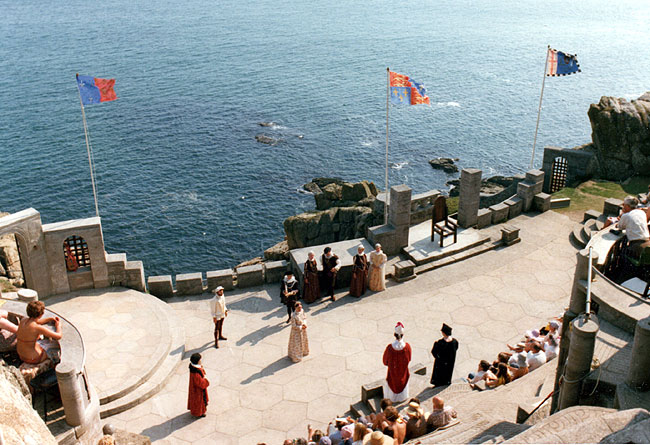
We should have been in Cornwall this month with The Great Gatsby. Can you believe it would have marked 45 years since the Tower's first trip to the Minack Theatre? Some recollections of that first production from David Holyoake, who was there, even though the name doesn't appear as such in the Tower's archive*! Explanation to follow ...
Prior to the Minack, I believe the previous open-air tour had been to Arles in South-East France, before I joined. This was reputedly not a financial success, and it made accountant and Financial Director Frank Smith very wary of any such mishap again. But he did go to Cornwall to see the show, though the climb up the hill from the Porthcurno beach car park was much too much for him.
However, Artistic Director Sara Randall would not be deterred, though as she was rehearsing the part of Martha in Who’s Afraid of Virginia Woolf? she couldn't take part herself. The show she agreed with Lawrence Shove, the Minack Theatre Manager, was Robert Bolt's Vivat! Vivat Regina!, and she took the theatre's advice and brought in a director who knew the Minack well and had directed several shows there for other companies, by the name of Ian Gibson. This turned out to be a very mixed blessing indeed.
Ian totally took control from the outset. He insisted :
- the show would be directed for Minack and reworked for later performance at the Tower, not vice versa as many had expected so that we could take a show on tour that had been 'run in'.
- the show needed tour managers who would take charge of finding accommodation for everyone. Remember back in 1975 there was no internet, let alone WWW or AirBnB. Everything had to be done by postal mail. The tour managers, Noreen and Jim Spall, also had to take charge of box office, publicity, front-of-house, and car parking (all now run by Minack staff, which they do very efficiently and have so become a major local employer).
- he insisted on having 2 stage managers, one each side of the stage with a crackly intercom between them. That was to be Jackie Valin and myself, but things didn't quite work out that way, as we shall see.
- he required a minimal set, believing that the location did most of the work for you. Set Designer Ron Brooker took this to heart. We had basically just 2 thrones and 4 flagpoles (scaffold poles with flags that could be raised or lowered depending on which Court - English or Scottish - was on stage at the time). Ian also warned Ron about potential problems with severe weather (no change to that, since, then), so Ron created 2 pairs of very well waterproof flags made of some sort of plastic material that could withstand being blown against the flagpoles by prolonged strong, blustery, winds. They survived really well, but during one day the noise of the flapping was so loud that we had to lower all 4 to allow the actors to be heard!
- he told everyone in the party that Monday was advertising day. We had to cover the whole area with posters, leaflets, people in costume walking the streets, anything that would get attention from locals or visitors, but absolutely no fly posting or putting leaflets under car windscreen wipers as the local District Council was very strict on this and could fine the theatre.
- he announced he had his own lighting designer and costume designer, both of whose names I have totally forgotten. Again, a mixed blessing.
So rehearsals went ahead, costumes were provided, sourced or made, and we eventually all set off, knowing we had to meet in the car park at noon on the Saturday to take control of the theatre from the previous production.
The first thing a time traveller would notice about going to the Minack 45 years ago and nowadays would be the journey. You may think it's a slog now. Back then you had to add delays caused by traffic jams on the narrow roads and busy centres of towns and villages on the way : Okehampton was already infamous for this on its own. Add Launceton, Bodmin, Jamaica Inn, Camborne, Redruth, Hayle, Long Rock and Penzance which all now have new by-passes. Not yet so around Truro, still single lane in each direction, with promises of a proper by-pass sometime this decade. Promises, promises. Also not yet Crowlas (no promises, no promises) and no improvements have been made west of Penzance whatsoever.
But when you do get to enter the Minack Theatre for the first time, that first view is absolutely stunning. If anything, it's actually improved over the years. Question : How can a sea view be improved? Answer : remove the raw untreated sewage which frequently got trapped by the tide off Porthcurno beach and looked very uninviting. We have much to thank local campaign groups for, especially Surfers Against Sewage, and the introduction of 'blue flag beach' awards, and very belatedly South West Water.
And so we all assembled at noon for the get-in. Not quite all, though. Where was Bob Dorney? A message eventually came through that his fiancée Suzanne Doggett had been rushed into hospital very seriously ill indeed, and he felt he could not leave her.
Bob had been due to take four small walk-on parts. Ian immediately decided that the best solution would be to give them to a 'spare' man who had been to every rehearsal - me. I had joined the Tower to avoid acting, particularly the drag of learning lines at which I found I was very slow, to everyone else's annoyance. However, two of the parts had no lines at all, just walking on and muttering agreement. The third was as the Doctor to Mary, Queen of Scots, who was asked by Gately Freeman as 'Darnley' : "The doctors say that is what she must do, don't they, Doctor" to which I had to reply "Yes, my Lord". Couldn't go wrong, could I? Only by being distracted by a cast member backstage asking an untimely question about the explosion that later killed 'Darnley', and missing my entrance completely. Gately coped, of course.
For that explosion - a stage maroon on the cliffs stage left - I had had to find the local Coastguard station and warn them, lest they thought it was a ship's distress signal. "At what times?" was not an easy question to answer, as we hadn't yet done a run-through on stage at that point! Fireworks are now commonplace at the end of a show.
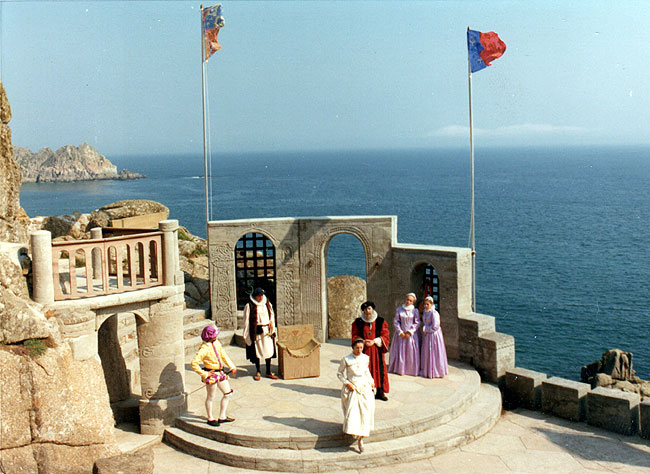
The fourth part I inherited was as the 'Cleric' who follows the 'Bishop of Durham' with just one repeated line of response to his verses. I could remember that, couldn't I? But again, something went wrong. The 'Bishop' was played at the Minack by John Blanchard. John was one of those actors with the knack of taking total control of the scene whenever he walked on stage. He had an amazing stage presence. But he was a nightmare for stage managers, forgetting what scene he was in - or even which trousers he should be wearing - when he next went on stage (as in Dance of Death).
Having mounted the then terrifyingly perilous steps from the backstage dressing room over the cliff edge to the back of the auditorium, we made our entry through the audience. One show, part way down, he switched lines on me, or rather he said my line as if it was also his. After a moment's silence, I gave out his next lines to which he responded with mine. And so we continued down the steps until he stopped on top of the 'prompt box' for his major monologue. I was in a panic - I certainly couldn't remember all that, but he sailed straight on from saying my last line into his big speech, and I gulped a sigh of relief. Did he ever know he'd done it?
Those perilous backstage steps have since been rebuilt and are now much safer, as is the case for the rail protecting the edge of the path at the rear of the stage over the zawn, and the auditorium paths too. Indeed the 1975 visitor would be amazed at the changes to the theatre's infrastructure. The old World War II 'pill box' used by Noreen, Jim and Roger Green as the box office - and which also housed the trip switch for the lights when there was a 'short' (a regular occurrence) - has gone, together with its numerous spidery inhabitants. There was no shop nor café, just a much smaller version of the coffee stall half way down the auditorium, presided over by Norman Fitkin and his wife, and they stood for no nonsense from a playing company. There was no exhibition centre, the car park was dirt, not tarmacadam, the overflow car park much smaller and boulder-strewn, and the the cricket field now occasionally used as another car park was, well, the village cricket field. Toilet facilities are much improved both in the dressing rooms and front of house. The dressing rooms were much smaller, and without any dryers. Wet costumes had to be taken to a nearby launderette, hopefully before the next show. Use of a hair dryer during the show was likely to throw the trip switch in the box office, plunging the stage into darkness. Not now. The entrance stage left, today concreted and often covered with a bandstand, was just sloping grass and quite slippery if wet.
And basically, the 'elfin safety' just hadn't made his appearance. By the end of the week's run, despite Roger's posters by the Minack entrance being eaten by snails every night, a combination of massive advertising effort tramping streets, word-of-mouth, good weather, and a glowing review from 'The Cornishman' brought us packed houses. I'm pretty sure we had over 1000 on the last night, to Frank Smith's relief. They were hanging onto rocks anywhere they could find, however far away. It wouldn't be allowed now. And remember, there was no sound system to take the actors' voices up to the top of the cliff at the back: actors had to project, not rely on these crackly and erratic radio-microphones which can make - or spoil - your enjoyment now.
On get-out Saturday morning, we found a tray of peaches in the dressing room. This was a sign that Miss Cade, the owner, approved of both the production, and more importantly, the way the playing company had fitted to the needs of the theatre. She was continually around somewhere - weeding paths, cleaning the toilets, never interfering but always keeping an eye on the situation.
But not everything was all sweetness and light. I have no idea what brought this on, but Ian Gibson fell seriously out with a cohort of the cast (not me, I assure you). So much so that he vanished in a huff, taking with him his lighting man and his wardrobe lady, together with all her costumes. Major problem : the Tower had very little time before the next performance, due at the Kenneth More Theatre in Ilford, before bringing the show to the Tower. Jimmy Horne ('William Cecil' ) took over as director and the wardrobe department worked miracles to create a good-looking show in both venues. I had started a new job that involved lots of travelling, and had never intended any involvement beyond get-in and strike. Though I recall finding the Kenneth More Theatre, I have no idea who took over 'my' parts.
A final lesson : Salubrious Terrace, St Ives sounded a wonderful place to stay for a Minack trip, not far on the map, so Noreen and Jim booked a group of us there : John Field, Ron Brooker and myself in one room, themselves in a second, Jackie Valin and another two ladies of the cast in a third. Bad move. St. Ives is far too far away from Minack late at night. Whichever way you go, the roads are, even now, narrow, tortuous, unlit and exhausting to drive when you're already tired, and even worse if you had to go via the night safe deposit box at the bank in Penzance to deposit the takings. At least we don't need that diversion now. Somebody - one of the men - snored loudly.
So the visit was classed as a success by (almost) everyone, including Frank Smith, and we have been invited back regularly ever since. It makes a huge contribution to both company spirit and our finances. Though not this year. With no trip to Paris either, that's a huge hole in our budget; our income at the moment is primarily membership subscriptions. Please keep them coming in even if you can't audition yet.
*Thanks to David for pointing out errors on the Tower’s archive page for the show. We've discovered that the London version of the programme had been used on the web site; we've now obtained the correct Minack programme and the web page has been updated.
|


