|
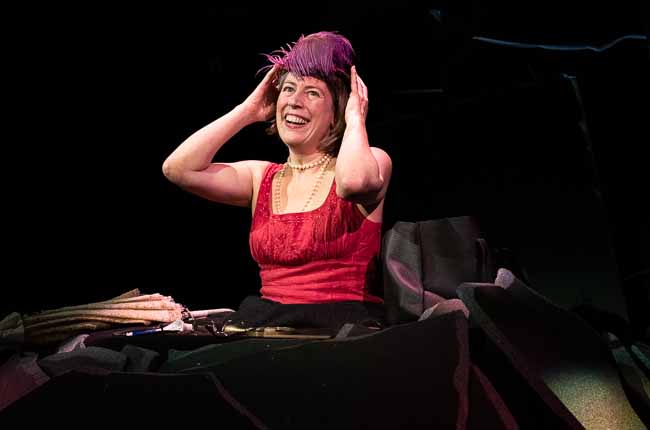 The actress Billie Whitelaw said about her experience of being directed by Samuel Beckett as Winnie in Happy Days tha , at one point "she could no longer endure the strain of Sam's obsession with the pronunciation, tone and emphasis of each syllable of every word in the long text". Beckett was notoriously particular about every word, stage direction, gesture and expression in the performance of all his work and it is fair to say that the importance of the actor, of the physical figure became less and less prominent as time went on leading eventually to Not I where the actor is not really present at all - just a pair of lips (on tv) or a disembodied voice. But in 1961 the actor is most definitely still there and in such a way that lead him to create one of the greatest twentieth century stage roles for a woman. Winnie has gestures, Winnie has expressions, Winnie even has props! - and most striking of all Winnie even has a companion, Willie - although whether he actually provides companionship is another matter; Winnie herself can't be sure and the audience, only seeing the back of his head in the first half are hard pressed to make a judgement either. "No better, no worse, no change".
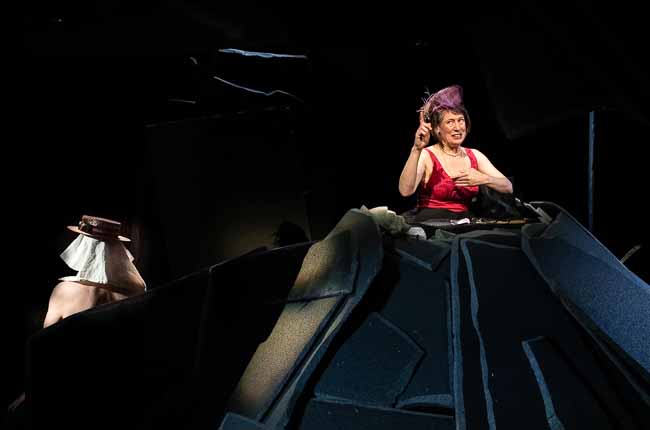
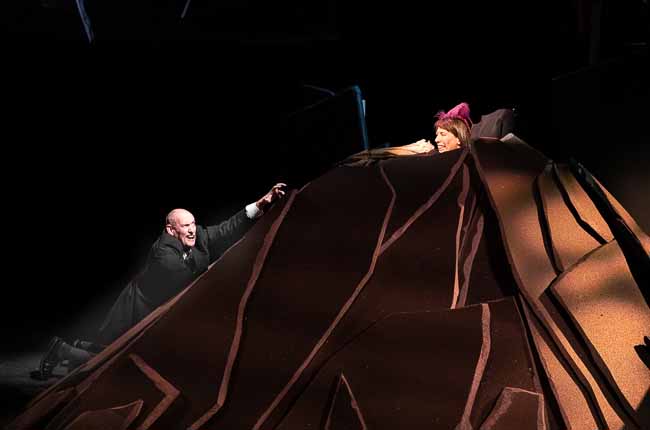
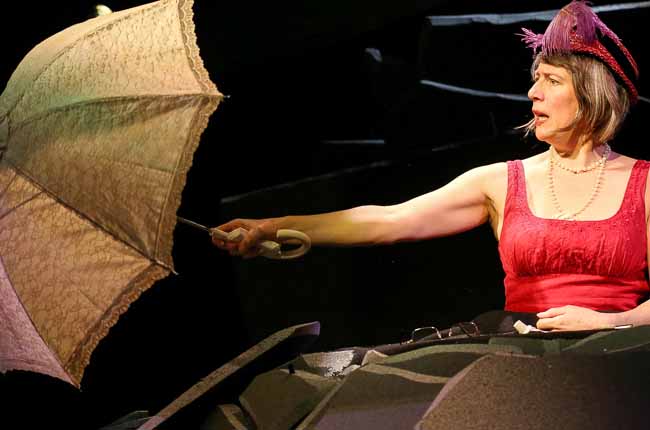 But back to the beginning. Presuming it is the beginning. Well, it's the beginning for us at any rate. Where are Winnie and Willie? It's usually said that Winnie is buried up to her waist, and then up to her neck, in sand, but the text simply says "mound" and on this occasion she seems to be entombed in what appear to be large pieces of slate, as if she had been forgotten in a quarry somewhere. This is no mild and rainy welsh situation though. The sun is beating down (hence the parasol), the earth is scorched and the dreaded term "post-apocalyptic world" comes to mind. But this is a post-apocalyptic world with toothpaste and a music box, with a bag whose contents magically replenish themselves or re-appear when they had appeared lost. A world that occasionally offers consolation and even (unseen) visitors who comment (if Winnie is to be believed) on her predicament, not that they do anything about it. Willie even has a newspaper from which he reads a few snippets - although whether this newspaper has been recently delivered, is the same one he has been reading for a decade or even eternity, or is just a repository of some of Winnie's memories (real or imagined) is up for discussion. At a tangent, the mention of Reynolds News is interesting as it was a paper originally founded to be "devoted to the cause of freedom and in the interests of the enslaved masses", which passed first to a Liberal MP and then to the Co-operative movement. A sort of ultra serious News of the World if you like.
You see? - "not a day goes by ... hardly a day, without some addition to one's knowledge however trifling, the addition I mean, provided one takes the pains".
But back to the beginning. Presuming it is the beginning. Well, it's the beginning for us at any rate. Where are Winnie and Willie? It's usually said that Winnie is buried up to her waist, and then up to her neck, in sand, but the text simply says "mound" and on this occasion she seems to be entombed in what appear to be large pieces of slate, as if she had been forgotten in a quarry somewhere. This is no mild and rainy welsh situation though. The sun is beating down (hence the parasol), the earth is scorched and the dreaded term "post-apocalyptic world" comes to mind. But this is a post-apocalyptic world with toothpaste and a music box, with a bag whose contents magically replenish themselves or re-appear when they had appeared lost. A world that occasionally offers consolation and even (unseen) visitors who comment (if Winnie is to be believed) on her predicament, not that they do anything about it. Willie even has a newspaper from which he reads a few snippets - although whether this newspaper has been recently delivered, is the same one he has been reading for a decade or even eternity, or is just a repository of some of Winnie's memories (real or imagined) is up for discussion. At a tangent, the mention of Reynolds News is interesting as it was a paper originally founded to be "devoted to the cause of freedom and in the interests of the enslaved masses", which passed first to a Liberal MP and then to the Co-operative movement. A sort of ultra serious News of the World if you like.
You see? - "not a day goes by ... hardly a day, without some addition to one's knowledge however trifling, the addition I mean, provided one takes the pains".
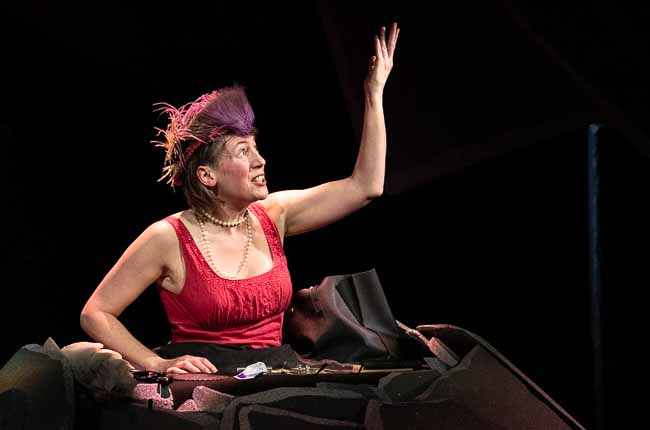
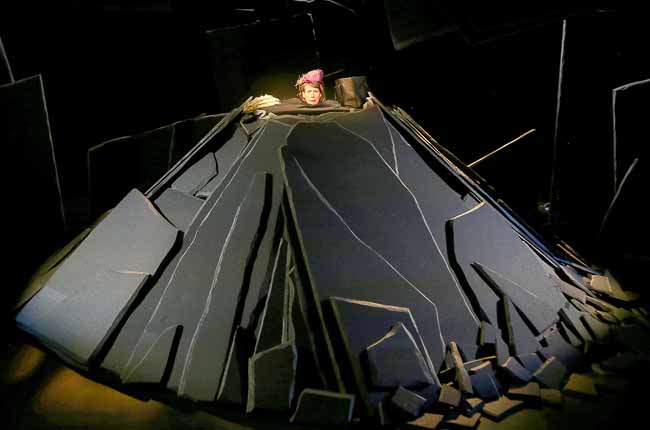 Ruth Sullivan as Winnie gives "to speak in the old style" a magnificent performance and is far from a static Beckettian figure even though she is indisputably immovable. She navigates the cheery, reflective, melancholic, pessimistic, realistic, deluded figure of Winnie through another day or days with considerable skill and love. You can't help but warm to her. It is worth mentioning at this point, that the audience member should make careful study of the brilliant photography of David Sprecher and Robert Piwko, displayed in the foyer. Not just for its technical brilliance and beauty but because it gives us many different viewpoints on Winnie, instead of just the one we had facing her straight on from the audience. She has hinterland - visual and emotional.
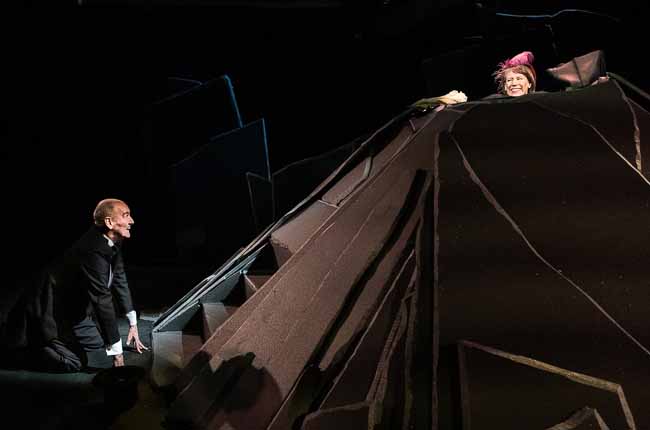 There is able support from Ian Hoare as Willie with (initially) only a straw boater and a hankerchief to protect himself from the elements, and a fiercer, more menacing persona in the second act when, dressed to the nines, he strains towards Winnie with a rictus expression on his face. She hopes she might be about to receive a touch or even a kiss, but the revolver is between him and her and it would not be unreasonable to fear the worst, or rather the inevitable.
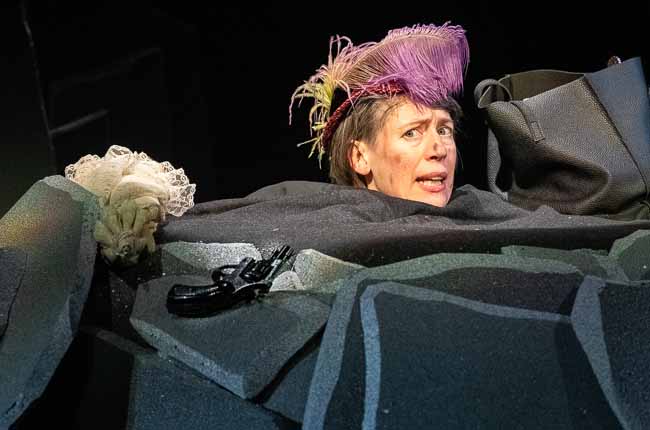 The direction from Robert Pennant Jones, is, as you would expect, masterful in the matter of Beckett with not a single second of doubt or distraction. Max's aforementioned set was brilliant in its black bleakness, which although faithful to the original concept also made you think that Winnie might be trapped in a slippage of one of earth's tectonic plates or the calvings of a monotone glacier. Sheila Burbidge had clearly attended to every one of sartorial needs including a quite wonderful hat that was almost a character in its own right. Stephen Ley kept us in the dark with Winnie an always shining beacon in front of us.
This staging is without a shadow of a doubt a considerable artistic achievement for the company, and one for which everyone involved is due a huge amount of congratulation.
The direction from Robert Pennant Jones, is, as you would expect, masterful in the matter of Beckett with not a single second of doubt or distraction. Max's aforementioned set was brilliant in its black bleakness, which although faithful to the original concept also made you think that Winnie might be trapped in a slippage of one of earth's tectonic plates or the calvings of a monotone glacier. Sheila Burbidge had clearly attended to every one of sartorial needs including a quite wonderful hat that was almost a character in its own right. Stephen Ley kept us in the dark with Winnie an always shining beacon in front of us.
This staging is without a shadow of a doubt a considerable artistic achievement for the company, and one for which everyone involved is due a huge amount of congratulation.
"Oh, this is a happy day".
Photography by David Sprecher and Robert Piwko
|