|
 In the considerable oeuvre of Alan Ayckbourn, there are several pairings of plays for children and for adults, related by a common theme. The Tower Theatre has apparently scored a first in staging one such pair in back-to-back productions. The Boy Who Fell Into A Book (1998), directed by John Chapman, ran from 20th-29th October, and was followed by Improbable Fiction (2005), directed by Phillip Ley, in the first two weeks of November. I thought both showed off to advantage many of the Tower's strengths. In the considerable oeuvre of Alan Ayckbourn, there are several pairings of plays for children and for adults, related by a common theme. The Tower Theatre has apparently scored a first in staging one such pair in back-to-back productions. The Boy Who Fell Into A Book (1998), directed by John Chapman, ran from 20th-29th October, and was followed by Improbable Fiction (2005), directed by Phillip Ley, in the first two weeks of November. I thought both showed off to advantage many of the Tower's strengths.
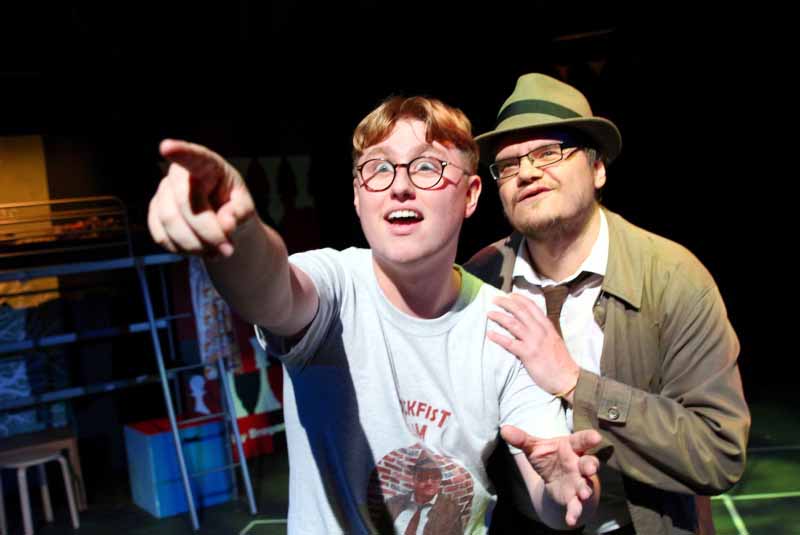 The Boy Who Fell Into A Book concerns the journey of 10-year-old Kevin through the world of his bedside bookshelf in a quest to return to his own room. Its creation coincided with the National Year of Reading in 1998 and is a markedly successful attempt by Ayckbourn to entertain whole families without ever 'talking down' to children. Interestingly, he is on record as never having enjoyed Pantomime, even as a child, but (before I read that) one of my strong impressions was of a successful lesson in how to deliver a panto that is going to work: a huge immediacy, enlistment of the audience in the emotions of the moment, and a larger-than-life overall approach to getting the action and plot across. To my ears and eyes, these were all definite pluses, and the youngest members of the audience when I attended were clearly gripped by the experience. A well-drilled repertoire of large and unmistakable gestures were evidence of Nevena Stojkov's input as Movement Director.
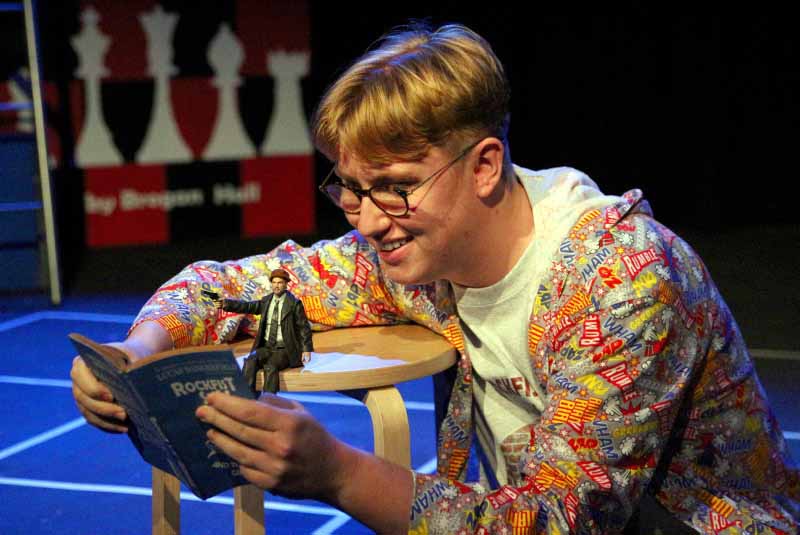
 Of course, if you succeed in winning your audience, you have to keep the pressure up so as not to lose them again – and in this regard I had enormous admiration for the performances of James Forth as Kevin and Matt Cranfield as Rockfist Slim. They seemed to leave the stage generally for only five seconds before reappearing through the centre black curtains, instantly transported into yet another challenging location – exhausting to watch, never mind perform!
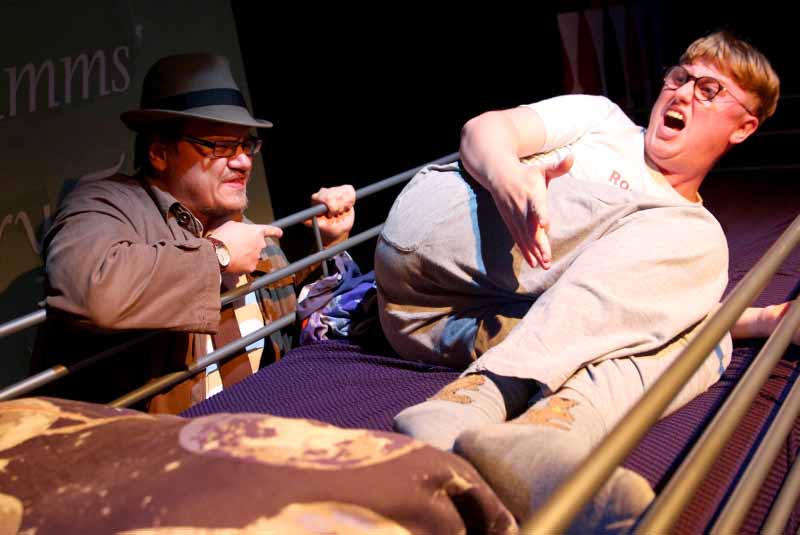 This flight of fantasy, of course, does not require elaborate sets – indeed, they would doubtless be a distraction – and the skilled writer and perceptive director know that the relevant worlds are being created in each onlooker's own mind according to his/her previous experiences, just as when reading a book. Rob Hebblethwaite's set design opted instead for giant representations of book jackets – hinting at the journey we were to undergo. A skilful choice, also, to focus on a single piece of furniture to do duty in many guises: Kevin's bunk bed, in which he tries to defy his (offstage) father's commands for 'lights out' at the beginning and end of the play, had a curtained lower space suitable for concealments and revelations as required by the plot, and could readily be shifted around the stage to become different things. Laura Corkell was in charge as Stage Manager (and Assistant Director).
 Lighting, naturally, had an important part to play: Stephen Ley's dramatic moments of contrast and scary childhood darkness were complemented by a swirly pattern indicative of the transition between different fictional worlds, and by a scary spectral projection onto one of the flats – Lighting Operator Anna Kidd. Here, too, Laurence Tuerk's sound design (and operation) was able to generate chills: echoing voices adding space to the darkened 'well' offstage – a sensible use of the lower mezzanine space behind the normal stage area.
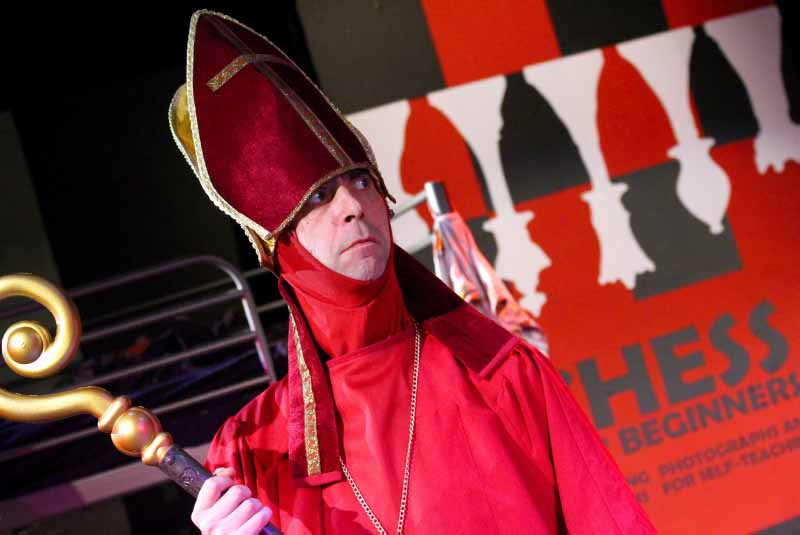 Kevin and Rockfist's progress through the bookshelf takes in detective fiction, Chess for Beginners, the Brothers Grimm, R L Stevenson's and unspecified ghost stories – which brings one to the vital, and very impressive, contribution from the Ensemble, comprising four protean actors, all making the most of opportunities to shine in supporting rôles.
Rachel Berg first appeared swathed in white as the White Pawn to introduce the Chess theme with suitably formal courtly language, soon afterwards reappearing as the White Queen, rather imperiously despatching her Red opponents. The Red Bishop (Matthew Ibbotson) matched her for self-importance (together with his trademark lugubrious expression), and the Red Knight (Carlos Fain-Binda) typically sought to out-manoeuvre her with his eccentric leap. All chess moves were according to the rules and the painted chessboard floor pointedly did not contain an eighth rank where 'queening a pawn' might otherwise have happened...
Kevin and Rockfist's progress through the bookshelf takes in detective fiction, Chess for Beginners, the Brothers Grimm, R L Stevenson's and unspecified ghost stories – which brings one to the vital, and very impressive, contribution from the Ensemble, comprising four protean actors, all making the most of opportunities to shine in supporting rôles.
Rachel Berg first appeared swathed in white as the White Pawn to introduce the Chess theme with suitably formal courtly language, soon afterwards reappearing as the White Queen, rather imperiously despatching her Red opponents. The Red Bishop (Matthew Ibbotson) matched her for self-importance (together with his trademark lugubrious expression), and the Red Knight (Carlos Fain-Binda) typically sought to out-manoeuvre her with his eccentric leap. All chess moves were according to the rules and the painted chessboard floor pointedly did not contain an eighth rank where 'queening a pawn' might otherwise have happened...
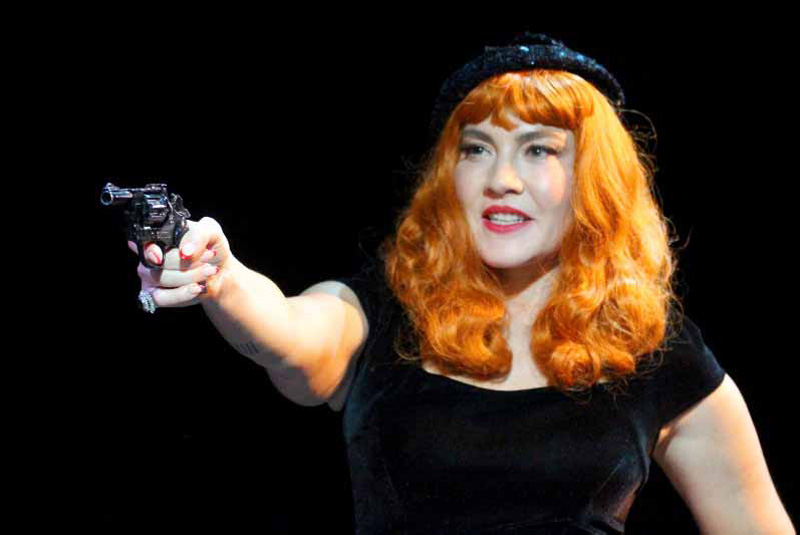
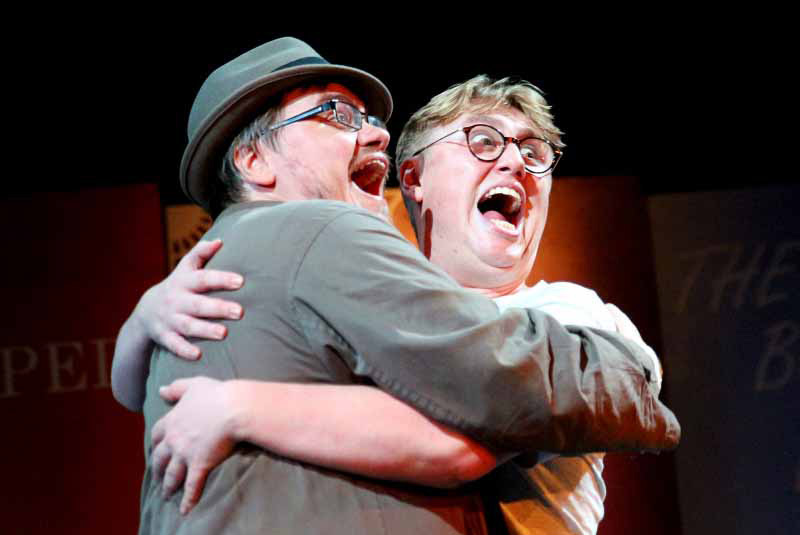 Rockfist Slim, the case-hardened gumshoe, had the expected Sam Spade turn of phrase, but his toughness was soon shown to be somewhat assumed, with Kevin actually proving the stronger partner in terms of drive and confidence. Rockfist's would-be nemesis, Monique was slinkily played in alluring black (and thick French accent) by Lucy Moss. Kevin slowly came to realise that he alone had the power to discover the future by 'reading on' – the only problem being the need to return to the bookshelf to do so. Monique's plan to foil her foes by suicidally burning the book provided the climactic moment of the story – thwarted, in the real world, by the impossibility of destroying every copy of the publication.
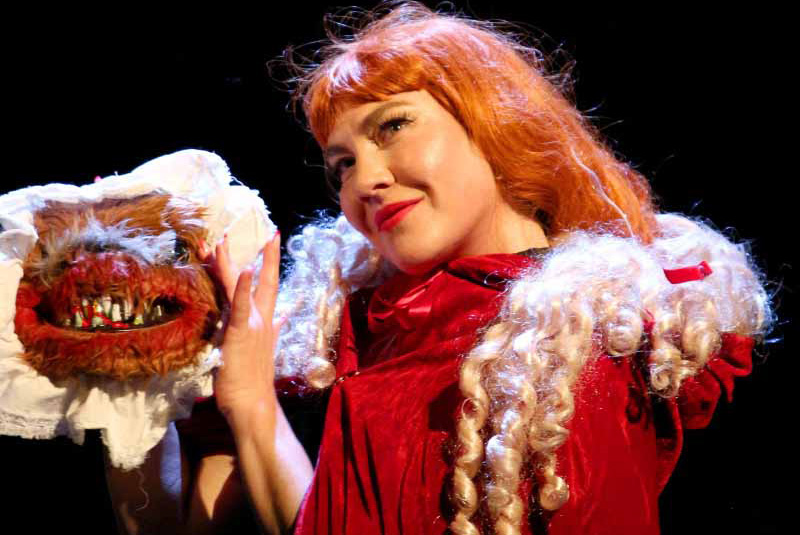
The Little Red Riding Hood episode saw Ms Moss as a lisping and suitably unaware title character, implausibly failing to spot the lupine features of Mr Fain-BInda as her grandmother's recent consumer. The 'tea'-party (though what was it in those cups?) was hilariously conducted in rhyming couplets – extending to Rockfist's struggling attempts to match.
Rockfist Slim, the case-hardened gumshoe, had the expected Sam Spade turn of phrase, but his toughness was soon shown to be somewhat assumed, with Kevin actually proving the stronger partner in terms of drive and confidence. Rockfist's would-be nemesis, Monique was slinkily played in alluring black (and thick French accent) by Lucy Moss. Kevin slowly came to realise that he alone had the power to discover the future by 'reading on' – the only problem being the need to return to the bookshelf to do so. Monique's plan to foil her foes by suicidally burning the book provided the climactic moment of the story – thwarted, in the real world, by the impossibility of destroying every copy of the publication.
The Little Red Riding Hood episode saw Ms Moss as a lisping and suitably unaware title character, implausibly failing to spot the lupine features of Mr Fain-BInda as her grandmother's recent consumer. The 'tea'-party (though what was it in those cups?) was hilariously conducted in rhyming couplets – extending to Rockfist's struggling attempts to match.
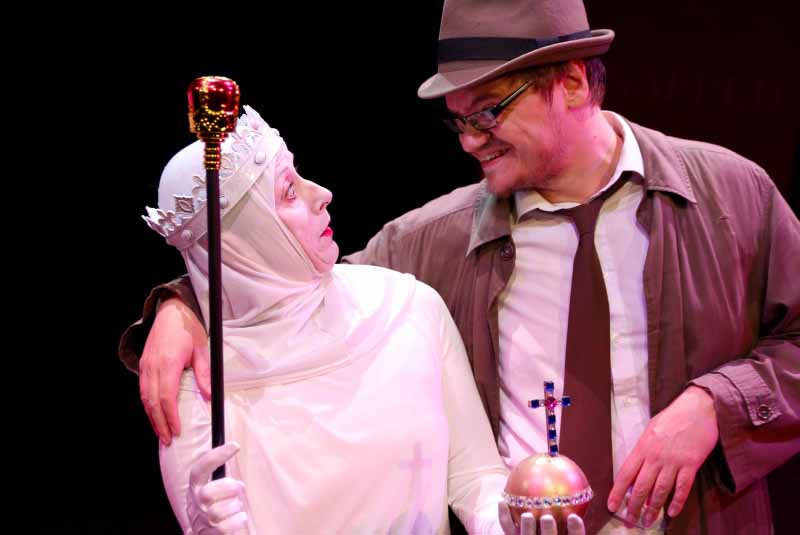 Kidnapped featured Matthew Ibbotson as the archetypal dour Scotsman Ebenezer who, though tricked into being sacrificed to Monique, turned out to be invulnerable because only fictitious.
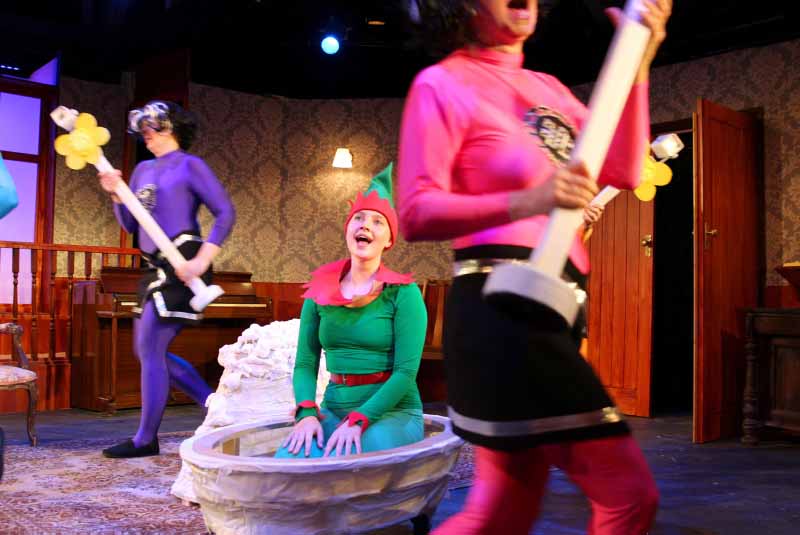
The centre set-piece of the evening was presumably a bit of an embarrassment for Kevin, as it originated from his younger sister's picture book of the Wooblies which had strayed onto his shelf. In what must be seen as a satiric parody of The Teletubbies, Ibbotson, Fain-Binda and Berg wore brightly-coloured costumes with hugely padded waists, and uttered dialogue consisting of variants on the one word “Woobly”. Their simple excursion involved a picnic and jelly, some of which got flicked. The narration, from the bunk-bed above them was, to say the least, tongue-in-cheek and irritatingly condescending (Moss). Ibbotson's Mother Woobly wig evoked for me (from a very different world) Mutha Bacon in Viz magazine (q.v.).
Kidnapped featured Matthew Ibbotson as the archetypal dour Scotsman Ebenezer who, though tricked into being sacrificed to Monique, turned out to be invulnerable because only fictitious.
The centre set-piece of the evening was presumably a bit of an embarrassment for Kevin, as it originated from his younger sister's picture book of the Wooblies which had strayed onto his shelf. In what must be seen as a satiric parody of The Teletubbies, Ibbotson, Fain-Binda and Berg wore brightly-coloured costumes with hugely padded waists, and uttered dialogue consisting of variants on the one word “Woobly”. Their simple excursion involved a picnic and jelly, some of which got flicked. The narration, from the bunk-bed above them was, to say the least, tongue-in-cheek and irritatingly condescending (Moss). Ibbotson's Mother Woobly wig evoked for me (from a very different world) Mutha Bacon in Viz magazine (q.v.).
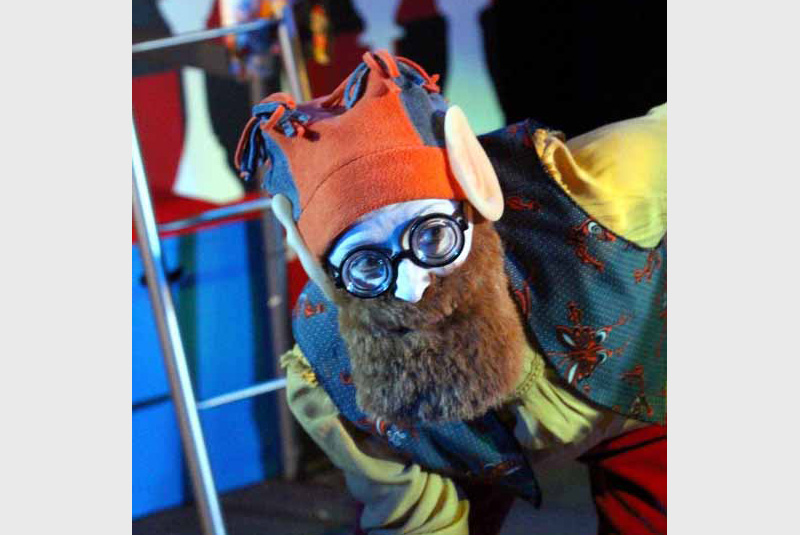 Leaving the best to last, one is left breathless at the achievement of costume designer Lynda Twidale. She is said to have 'put in the hours' to create a stunning array of generally from-scratch costumes: chessmen, Wooblies, Brothers Grimm characters and many more, with a very professional dash and imagination.
Thanks to very committed ensemble work, fabulous pace and a strong sense of theatricality, John Chapman's production I found to be easily of the highest aspiration and results in all departments – a Tower show to be proud of.
Leaving the best to last, one is left breathless at the achievement of costume designer Lynda Twidale. She is said to have 'put in the hours' to create a stunning array of generally from-scratch costumes: chessmen, Wooblies, Brothers Grimm characters and many more, with a very professional dash and imagination.
Thanks to very committed ensemble work, fabulous pace and a strong sense of theatricality, John Chapman's production I found to be easily of the highest aspiration and results in all departments – a Tower show to be proud of.
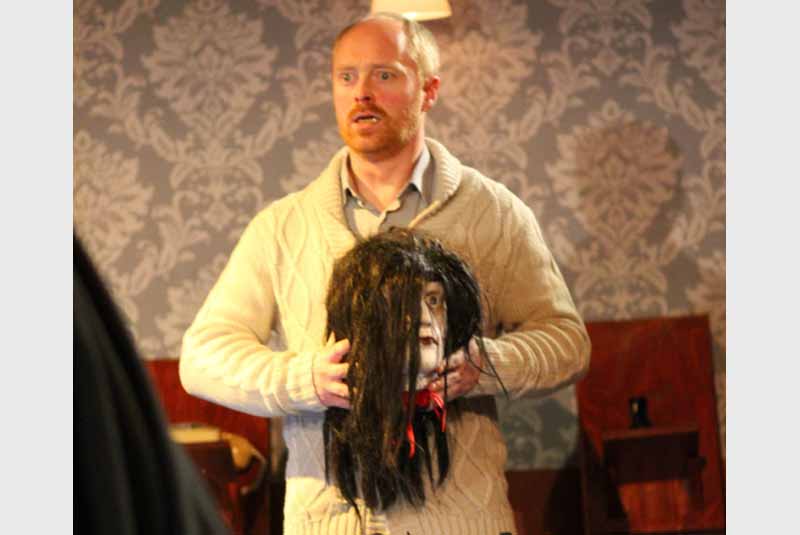
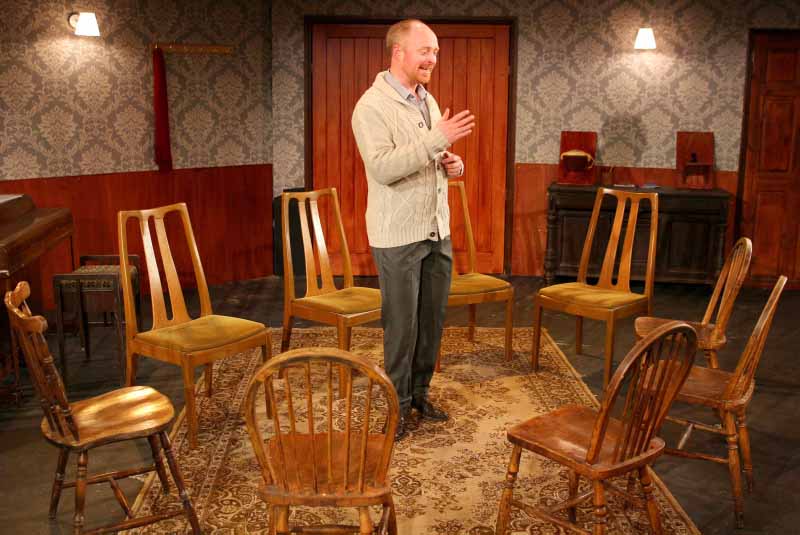 Improbable Fiction has a similar premise as The Boy Who Fell, but with less of a specific goal in mind. The central character, Arnold Hassock, is thrust unpredictably around by the actions of (as yet unwritten) fiction. The voyage of discovery undergone by Arnold is markedly different from that of Kevin. Kevin is aware of the situations and characters he meets (and indeed some of the future developments) through having read them, and can therefore lead the action. Arnold, by contrast, takes all the strange encounters and characters in his stride without apparently finding any need to combat them in any way – just smiling pacifically through it all, as if aware that these stumbling attempts by his writers' group are indeed merely in his head where they can't hurt him. In this rôle Sean McMullan impressively retained this equanimity (and his chunky cardigan) as instructed by the author – to what would be an irritating degree if one met him in reality. Accused at various times of killing his aunt or wife, he mostly just grins forgivingly – one didn't really know whether to admire his forbearance or shout out instructions about fighting back!
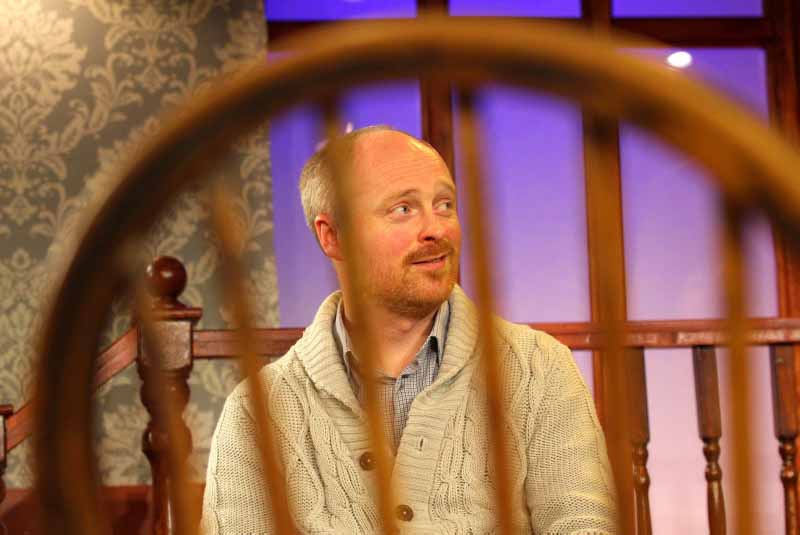 Despite (and because of) what one knows in advance about the plot, the opening action seems very low-key: Arnold seems to have an innate inability to count the chairs arranged for the monthly meeting. The set, designed by director Phillip Ley, immediately impressed us with its spacious and comfortable sitting room, wood-panelled and splendidly wallpapered, with practical wall lights, suitable for later atmospheric dimming. A raised and balustraded passageway led to other rooms, allowing for a little positional drama in Act II.
 First to arrive is the attractive young Ilsa (Isabelle Boreham) in a Rudolph Christmas jumper – not a writer, but here to read to and otherwise attend Arnold's unseen, offstage mother. There is a very brief and unexplained poignant moment when she gives Arnold a small twinkling Christmas tree, which he decides will enliven his mother's room – and she is clearly hurt by his indifference, despite having an unseen but audible motorcycling boyfriend. Later she provides the meeting – agonisingly slowly and boringly – with tea, while the writers share their views as to her ethnic/national origin (she's actually rural English!). The germ of the play is said to be an occasion when Ayckbourn was engaged to address a writers' circle, discovering that it was more in the nature of a social gathering rather than anything to do with actually producing any written work. Besides clarifying what types of writer we have, he plays the additional ironic joke of showing that their relationships as a group have none of the mutual encouragement and support you would hope for, but are in fact hardly civil. Such is the wide range of their interests and backgrounds that they don't have (and make no effort to find) anything in common. Arnold does his best to keep the peace, but his amiable demeanour doesn't allow him to try anything more forceful.
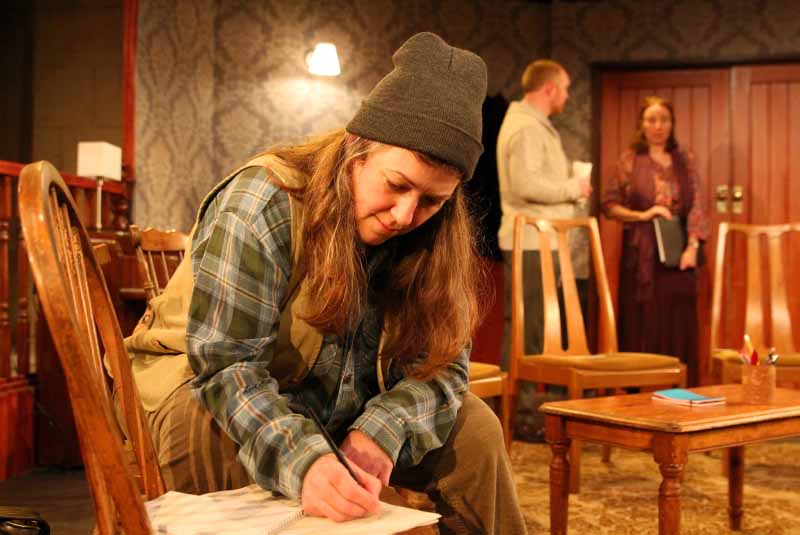
 The children's book illustrator, Grace Sims, hasn't yet committed plot or dialogue to the blank pages opposite her lovingly created pictures of Doblin the Goblin and his friend Sid Squirrel. The artwork is circulated for everyone's admiration – rather lukewarm at best, except for Arnold's strenuous efforts to be positive about all creative contributions. Stephanie Irvine played Grace with an uncomfortable combination of personal self-doubt and open disapproval of, in particular, farmer Jess Bales (Julia Blyth). Ms Bales inclines to early-19th century costume melodramas heavily larded with purple prose, and again Ms Blyth convinced as the purposeful writer - jotting away during the action and oblivious to any social politeness. The seemingly confident journalist and crime-story writer, Vivvi Dickins (Sophia Chrisafis) has several past works finished (but none published) and seems to be searching for the elusive Mr Right.
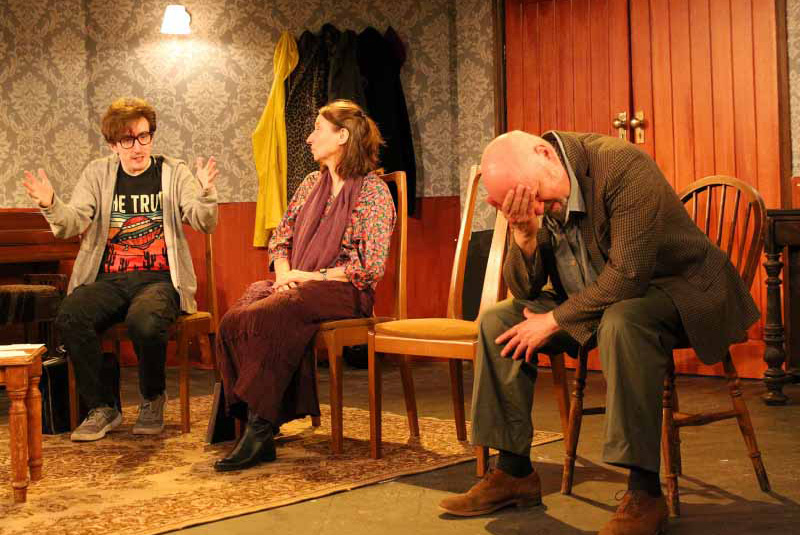 Nerdy Clem Pepp (Tony Sears) writes derivative sci-fi stuff by the yard – thinly disguised versions of local Town Hall shenanigans, he darkly hints. One worried for his mental balance as he lost his temper with his uninterested fellow writers whom he had thoughtfully supplied with a stapled synopsis of Chapters 1 to 7... Finally, retired headmaster Brevis Winterton (Richard Hague) opens the piano to give us a tune he has composed towards his musical adaptation of The Pilgrim's Progress, but has to sing it mostly to 'La' on account of the departure of his librettist, John Chapman. [This, incidentally, was the prize in some competition or draw won by our own John Chapman, director of The Boy Who Fell: a mention in an Ayckbourn play]. Brevis' other contribution is to belittle others' opinions and efforts in a world-weary Yorkshire accent. Clem's malapropisms drive him to distraction: he and possibly Ilsa have passed through his school. Nerdy Clem Pepp (Tony Sears) writes derivative sci-fi stuff by the yard – thinly disguised versions of local Town Hall shenanigans, he darkly hints. One worried for his mental balance as he lost his temper with his uninterested fellow writers whom he had thoughtfully supplied with a stapled synopsis of Chapters 1 to 7... Finally, retired headmaster Brevis Winterton (Richard Hague) opens the piano to give us a tune he has composed towards his musical adaptation of The Pilgrim's Progress, but has to sing it mostly to 'La' on account of the departure of his librettist, John Chapman. [This, incidentally, was the prize in some competition or draw won by our own John Chapman, director of The Boy Who Fell: a mention in an Ayckbourn play]. Brevis' other contribution is to belittle others' opinions and efforts in a world-weary Yorkshire accent. Clem's malapropisms drive him to distraction: he and possibly Ilsa have passed through his school.
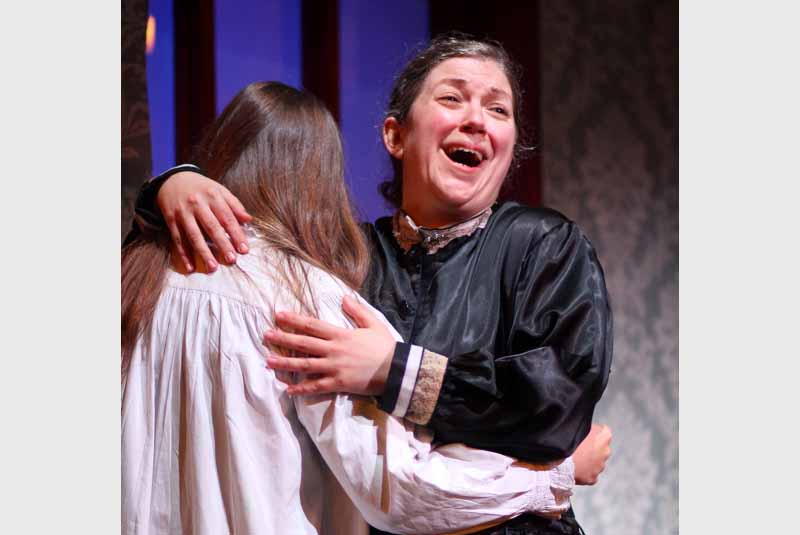
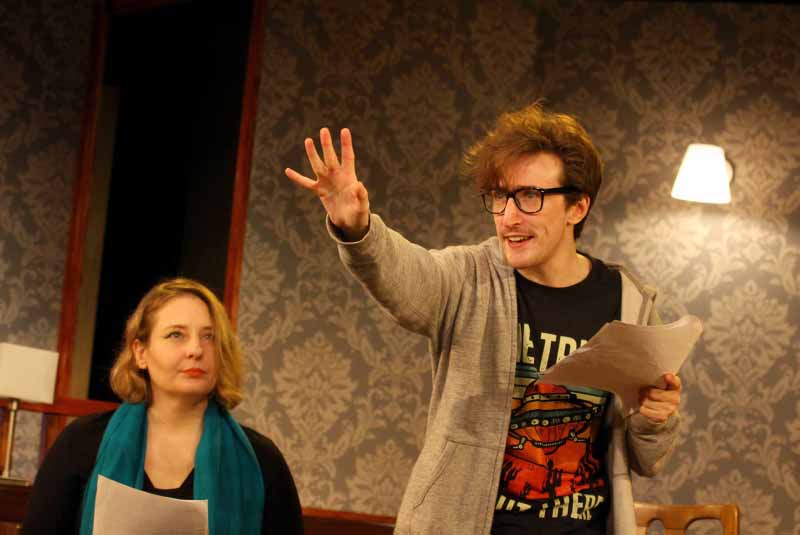 While we have learned a fair bit about those present, they have achieved very little, and the meeting breaks up with timid objectives sketched in for 'next time'. With a clap of thunder the lights go out and a young woman with nightdress, candle and kitchen knife appears (Ilsa), threatening Arnold as the victimised heiress of Jess Bales' gothic novel, as the Act I curtain drops.
One of the purposes of Act II is to allow all the writers a chance to play a number of different characters with carefully-judged minimum costume-change times for heightened effect. The writers' own personalities are subsumed in the fictional ones they adopt, and it quickly becomes clear who has contributed which bit.
While we have learned a fair bit about those present, they have achieved very little, and the meeting breaks up with timid objectives sketched in for 'next time'. With a clap of thunder the lights go out and a young woman with nightdress, candle and kitchen knife appears (Ilsa), threatening Arnold as the victimised heiress of Jess Bales' gothic novel, as the Act I curtain drops.
One of the purposes of Act II is to allow all the writers a chance to play a number of different characters with carefully-judged minimum costume-change times for heightened effect. The writers' own personalities are subsumed in the fictional ones they adopt, and it quickly becomes clear who has contributed which bit.
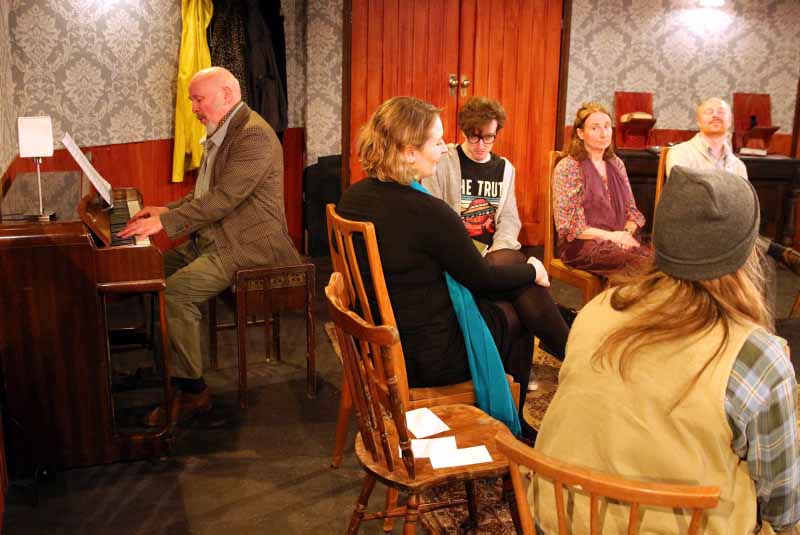 As the action picks up from the Act I curtain, Jess appears as governess/narrator, explaining the plot from the cover of a corridor. Clem is the villainous brother intent on relieving his sister of her inheritance and Brevis appears as the family doctor. In a sudden jolt, the lighting comes dimly up and we are in 1930s detective-story mode, with Clem in charge of investigation with his sidekick sergeant, played by Vivvi. Eager to please, she revelled in the one moment when she received approval for her deduction – an echo of her search for an appreciative man.
One 'star of the show' was the wooden panel above the sideboard, capable of showing in turn a modern telephone, a 'candlestick' instrument, or none at all, depending on the period setting currently required. Although subtly performed the first few times, the change became progressively more visible, eventually happening within full lighting – I like to think this was a deliberate choice, poking fun at quick changes generally!
As the action picks up from the Act I curtain, Jess appears as governess/narrator, explaining the plot from the cover of a corridor. Clem is the villainous brother intent on relieving his sister of her inheritance and Brevis appears as the family doctor. In a sudden jolt, the lighting comes dimly up and we are in 1930s detective-story mode, with Clem in charge of investigation with his sidekick sergeant, played by Vivvi. Eager to please, she revelled in the one moment when she received approval for her deduction – an echo of her search for an appreciative man.
One 'star of the show' was the wooden panel above the sideboard, capable of showing in turn a modern telephone, a 'candlestick' instrument, or none at all, depending on the period setting currently required. Although subtly performed the first few times, the change became progressively more visible, eventually happening within full lighting – I like to think this was a deliberate choice, poking fun at quick changes generally!
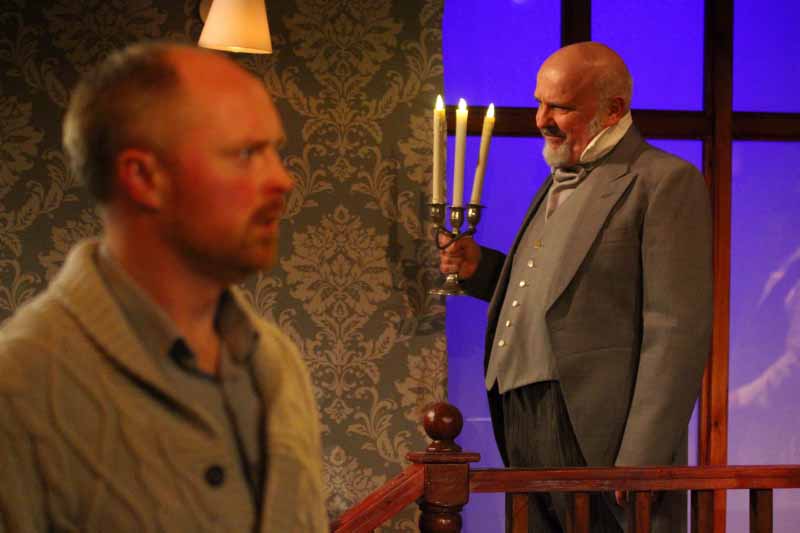 With brutal contrast we are then thrust into the world of sci-fi, represented initially by Brevis in a risible all-in-one cyan costume with wide black belt, reminiscent of Blake's Seven – congratulations due to costume designer Jean Carr and her helpers. Brevis (as if to punish him) has to deliver Clem-like language complete with his trademark malapropisms. Here the plot seems to be about aliens and the setting up of protective force beams in order to capture the invaders. Gradually the other writers join him, each in his/her lurid colour, to gradually increasing hilarity.
In the other worlds, the ne'er-do-well brother is foiled in his attempt to scare his sister to death; the 1930s victim's soignée sister (Grace) is revealed to be the murderess; and back in the 22nd century, the nutshell pod (feared to be the alien invasion) is instead shown to contain Doblin the Goblin (Ilsa). Joined by Sid Squirrel, the whole company ends with a ridiculous dance based on Brevis' music, with the detection-posts doing duty as dance-canes.
With brutal contrast we are then thrust into the world of sci-fi, represented initially by Brevis in a risible all-in-one cyan costume with wide black belt, reminiscent of Blake's Seven – congratulations due to costume designer Jean Carr and her helpers. Brevis (as if to punish him) has to deliver Clem-like language complete with his trademark malapropisms. Here the plot seems to be about aliens and the setting up of protective force beams in order to capture the invaders. Gradually the other writers join him, each in his/her lurid colour, to gradually increasing hilarity.
In the other worlds, the ne'er-do-well brother is foiled in his attempt to scare his sister to death; the 1930s victim's soignée sister (Grace) is revealed to be the murderess; and back in the 22nd century, the nutshell pod (feared to be the alien invasion) is instead shown to contain Doblin the Goblin (Ilsa). Joined by Sid Squirrel, the whole company ends with a ridiculous dance based on Brevis' music, with the detection-posts doing duty as dance-canes.
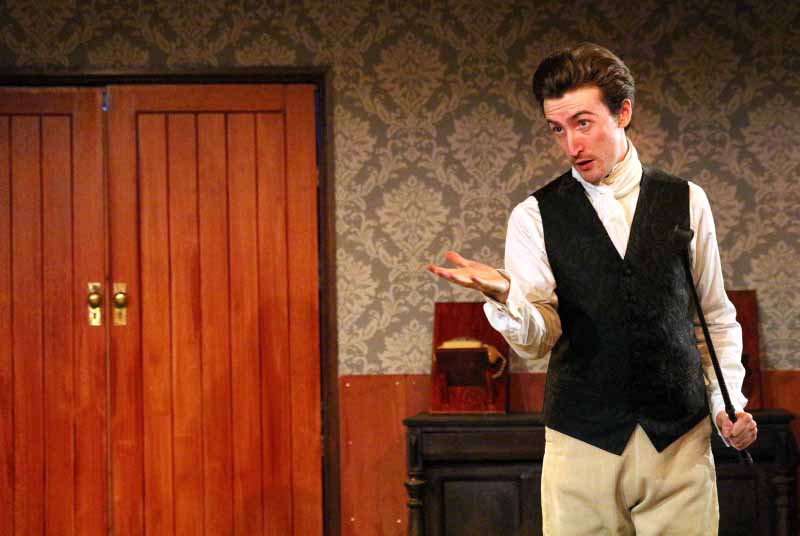 It seems the play was well received as part of the Scarborough 50th anniversary season, but attracted lukewarm reviews and even dislike during the national tour. Its apologists suggest that these detractors missed the point, citing Ayckbourn's stated intention of creating a light piece celebrating theatre without requiring any particular depth or insight – it has proved very popular with amateur companies.
A very capable and enjoyable Tower production of one of his trickier creations: pacey, technically excellent, with strong and enjoyable performances all round.
It seems the play was well received as part of the Scarborough 50th anniversary season, but attracted lukewarm reviews and even dislike during the national tour. Its apologists suggest that these detractors missed the point, citing Ayckbourn's stated intention of creating a light piece celebrating theatre without requiring any particular depth or insight – it has proved very popular with amateur companies.
A very capable and enjoyable Tower production of one of his trickier creations: pacey, technically excellent, with strong and enjoyable performances all round.
Photography by Robert Piwko
|