|
 "Here was the secret of happiness, about which philosophers had disputed for so many ages, at once discovered; happiness might now be bought for a penny, and carried in the waistcoat-pocket; portable ecstasies might be had corked up in a pint-bottle; and peace of mind could be sent down by the mail". Thus wrote Thomas De Quincey in his famous homage to 'relaxing substances', "The Confessions of an English Opium Eater" or as Tommy, over a century and a half later puts it in "Confessions of a Scottish Heroin User" better known as Trainspotting : "This is pure fucking brilliant Mark, ah'm fucking buzzin' here...ah'm just pure buzzin'..."
 Rather like those people who've never seen Star Wars, I have no previous direct experience of one of the most successful cultural phenomena of recent decades, never having seen the film (except in clips) or read the original novel of Trainspotting. Such has its success been however that its memes (as the kids say these days) have permeated more widely than its loyal band of aficiandos and it has even had a book written about its significance. It is therefore worth asking what the exact nature of its appeal has been. There is, of course the slapstick and dirty joke element of the whole thing - as Harry Gibson put it "the appeal of the deviant to the straight" but there must be more to it than that, especially as its success has transferred across different mediums - not always the case for bestsellers. Theatre is, in many ways, the ideal medium for Trainspotting as unlike film where special effects and historical vistas can be added, and print where the characters are only on the page (and in your mind), on stage you see them right in front of you, addled, flawed human beings doing the best they can to destroy themselves.
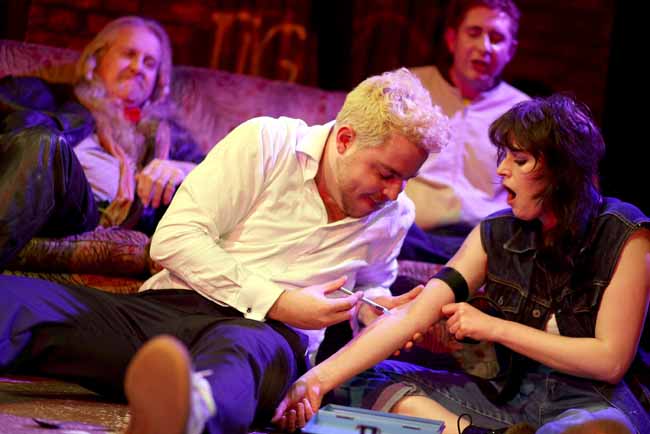
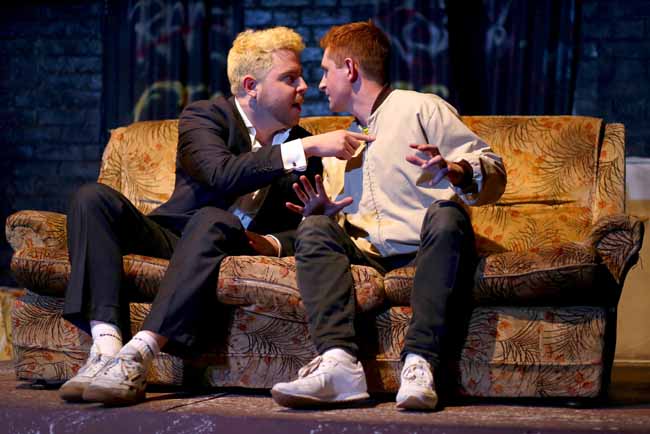
 The central character Renton, wears a bewildered expression throughout the action, sometimes in ecstasy, sometimes in desperation as though he can't really believe what has happened to him but, at the same time doesn't really care. It's almost impossible not to like him despite his being a physical mess and a moral vacuum. Paul Graves manages to elicit our sympathy even while having sex with his brother's widow at his funeral (I can't believe I just said that) and it was a commendable performance all round. Surely no-one on the British stage can have taken their trousers on and off so many times, since the days of Brian Rix in the Whitehall farces. He clearly doesn't see himself as a bad person especially when compared to Begbie, played by a steely eyed Ryan Williams, a truly terrifying character who made me doubly glad of my decision not to sit in the front row, towards which he made several menacing forays. (I didn't catch what he said to the unfortunates there, I was too busy hiding behind my programme). You wouldna wan to mess wi him. Renton memorably recounts that he only made any effort at school to try and get away from Begbie in the O level class - "didnae work" - and gives the somewhat bewildering explanation that Begbie is a mate despite being "a cunt of the first order", but this begins to make sense the more you see of the characters, and you realise they do have something of the feel of a family about them. Admittedly more like a skanky, skint and scabrous Scottish version of the Borgias than the Waltons or the Archers but a family nonetheless. They have a lot of shared experience (most of it bad or illegal or both) and have a bond that weirdly if self interestedly endures the slings and arrows of outrageous opiates.
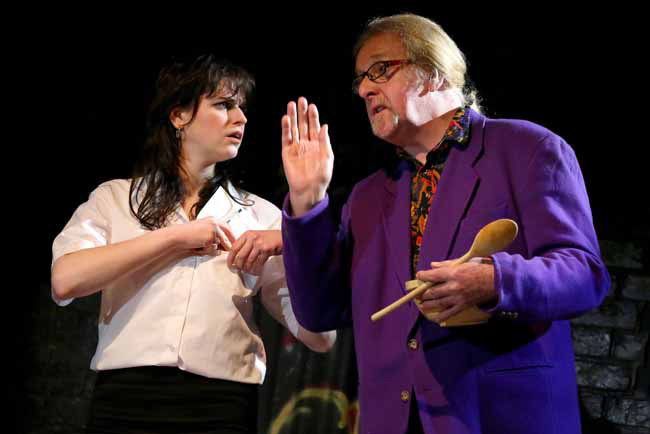
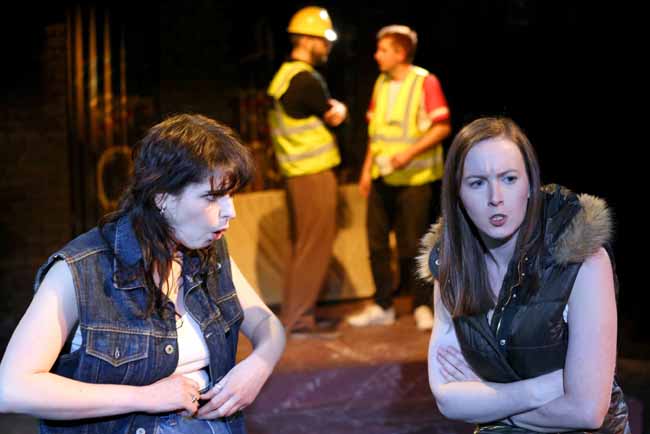
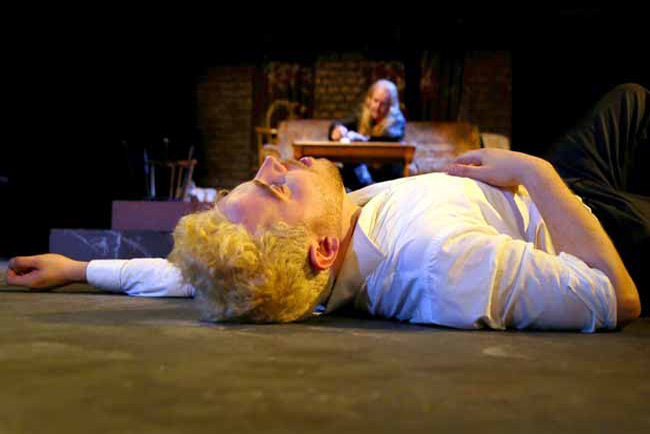 Ben Kynaston as Sick Boy is the tragic figure of the group as he thinks he can handle the drugs, but can't and is only going one way whereas others "unfairly" survive. I thought his decline was well observed and consistently managed. His bleached hair lighting the scene even when we were in total darkness, this was a nice change of pace from his previous roles in King Charles III and we wanted to help him, when of course he was beyond all help. Alexander Gordon Wood is the pater familias of the tribe although not one you would ever consult for fatherly advice. Nicknamed Mother Superior as he has a very long habit (geddit?), he is another survivor even when he loses most of a leg and embarks on a new career as a fake Falkands veteran complete with unearned medals and Union Jack "bandage". I was reminded of his role in The Slab Boys several years back, his sonorous authority undermined by depravity, despair and dishonesty. Although drug addiction is an equal opportunity employer, it is clearly a macho, male-dominated environment beset by misogyny, domestic violence and second class status. Rebecca Allen was, in various guises, patronised, abused, hit in the stomach while pregnant and more. Her ability to morph from old to young and be equally convincing was particularly to be admired, especially in a piece which has such a youthful slant to it. Ailsa Dann, while slightly less put upon in the great scheme of things and slightly more in control certainly doesn't have an easy time of it and gave a quiet (and sometimes quite noisy) dignity to all of her characters. If any of them survive long enough in this world you could imagine that hers will ultimately rise up while the others sink back or go under.
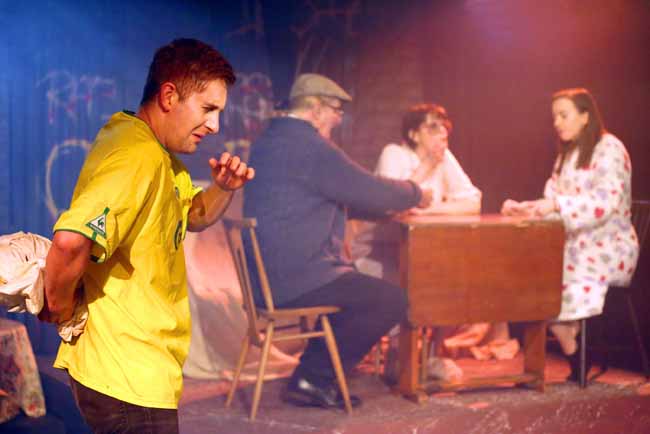
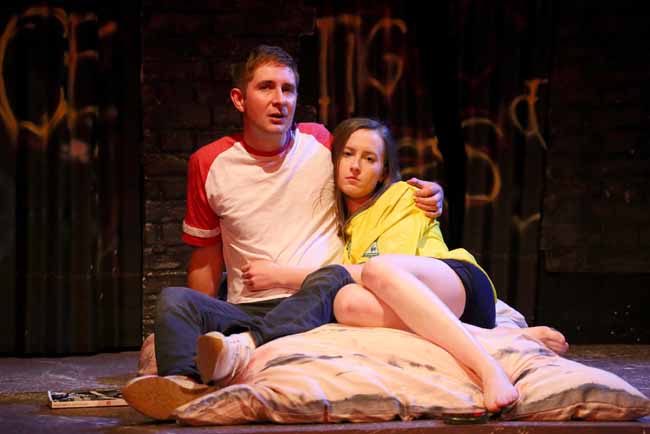 Director James McKendrick made the correct decision to open out the personnel of the play from the original hard core four, so that more of the action is acted out rather than just narrated. This is particularly useful in scenes like the one at the breakfast table when Renton's excesses catch up with him in the most graphic way (I won't spoil it for you) and the whole dissolute and dispersed set of tales hung together quite impressively. There was no question of getting confused or lost even in the mayhem of low-life Leith. I wasn't sure that the disco needed to be running for so long at the beginning as the audience came in, but the atmosphere and tone, once fixed, never wavered. A suitably scummy set courtesy of Jude Chalk and Max Batty did the trick on the deprivation index and deceptively dingy settings still showed Stephen Ley's lighting skills to their best effect, and vice versa. Rob Hebblethwaite's soundtrack was stuffed with little gems which only some of us of a certain age remember, although some of them for too short a time. Rachel Bothamley and Eva Leigh's clothes caught the time accurately, down to the two Hibernian shirts from the garish polyester era of Scottish football.
 While I suspect that Walter Scott and Rabbie Burns would have blanched at such squalid scenarios, Welsh's hell bound entertainment sounds an echo from James Hogg's Ettrick Shepherd , and as the inventor of Dr Jekyll and Mr Hyde I suspect Robert Louis Stevenson would have understood too. Trainspotting is from a great Scottish literary tradition of dancing with the devil and while things are a bit repetitive at times, the director and cast have honoured this tradition with his vision and their performances.
Times have changed since this Leith crew replaced their local police force as its most famous residents. The area has gone upmarket, (not to say boho) with some of Edinburgh's better pubs and restaurants; once endangered like the white rhino there are now more Tory MPs in Scotland than Labour ones, Heroin has been shoved down the drugs pecking order by laboratory created substances, Leith's three closed railway stations have been long forgotten and trams once more roam the streets. Hibernian have even managed to win their first Scottish cup in over a century. The world is truly changed, even in so short a space o'time. We should probably leave the last word to the twentieth century's most famous junky, William Burroughs, in his book of the same name : "Most addicts I have talked to report a similar experience. They did not start using drugs for any reason they can remember. They just drifted along until they got hooked". Drift to the Tower before Saturday week and get hooked yourself.
While I suspect that Walter Scott and Rabbie Burns would have blanched at such squalid scenarios, Welsh's hell bound entertainment sounds an echo from James Hogg's Ettrick Shepherd , and as the inventor of Dr Jekyll and Mr Hyde I suspect Robert Louis Stevenson would have understood too. Trainspotting is from a great Scottish literary tradition of dancing with the devil and while things are a bit repetitive at times, the director and cast have honoured this tradition with his vision and their performances.
Times have changed since this Leith crew replaced their local police force as its most famous residents. The area has gone upmarket, (not to say boho) with some of Edinburgh's better pubs and restaurants; once endangered like the white rhino there are now more Tory MPs in Scotland than Labour ones, Heroin has been shoved down the drugs pecking order by laboratory created substances, Leith's three closed railway stations have been long forgotten and trams once more roam the streets. Hibernian have even managed to win their first Scottish cup in over a century. The world is truly changed, even in so short a space o'time. We should probably leave the last word to the twentieth century's most famous junky, William Burroughs, in his book of the same name : "Most addicts I have talked to report a similar experience. They did not start using drugs for any reason they can remember. They just drifted along until they got hooked". Drift to the Tower before Saturday week and get hooked yourself.
Photography by Robert Piwko
|