|
 Produced and partially-directed by Landé Belo, Ain't I A Woman? comprises five short plays which explore the unique intersectional impact of gender and race on black British women. Though each play embodies a setting, perspective, writer, style and cast of its own, all are a lucid nod to the sentiments expressed in the eponymous speech by Sojourner Truth. The performance overall is a needed and a noteworthy theatrical experience, with thought-provoking subject matter conveyed via powerful moments of acting.
Guiding the audience through pieces ranging from dystopian sci-fi, thot rom-com, and a GB-news inspired interview, are emotional live musical performances composed by Isabelle Ajani - her first theatrical composition. Alongside Ajani’s piano accompaniment, we are treated to the sumptuous Bessie Smith-like vocals of Chaachi Deane and Anoä-Kanelle Calpas. Both singers are adorned in opulent costume arranged by costume designer, Roxanne Ivy Roberts.
 I.
I.
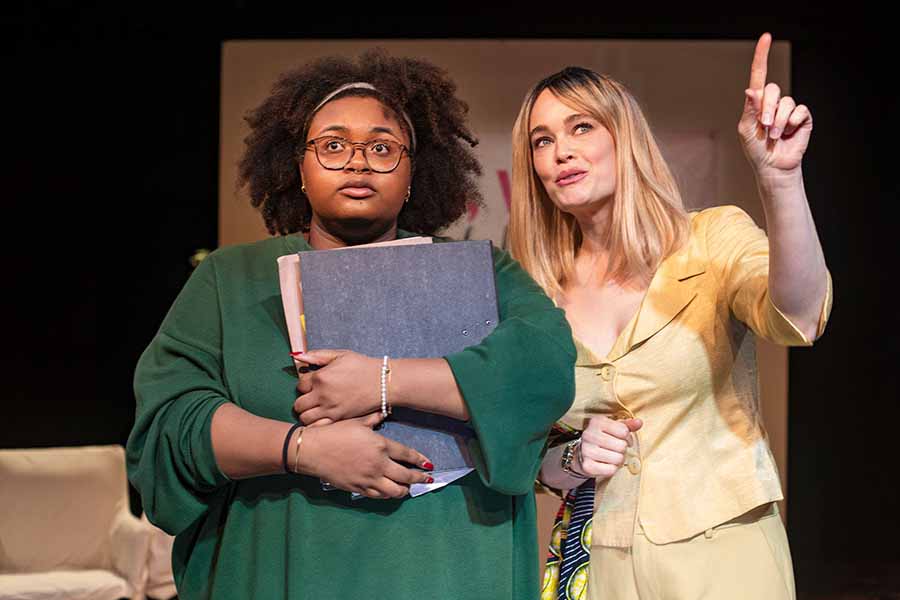
The first play, Changing Rays, is a chilling yet satirical exploration of the psychological impacts of Western beauty norms on black women, and considers where one’s desperation for acceptance can lead. Written by Mauricia Lewis and directed by Landé Belo, the play takes place in a dystopian world in which Ngozi, a young black woman played by Anoä-Kanelle Calpas feels so afflicted by her born race that she seeks out the services of "Changing Rays", a company fronted by Kailee O’Sullivan’s character, Karen. Karen promises to 'correct' racial inferiority through cosmetic alteration and personality adjustment. She makes constant attempts to convince Ngozi to go ahead with the procedure, presenting it as a prized opportunity to wholly transform her life. O’Sullivan is superb in her portrayal of this well-meaning, yet deeply unsettling character, whose matter-of-fact, Colgate-smile delivery suggests Karen’s obliviousness to the horrific implications of the treatment she promotes. This is in stark contrast to Calpas’ valid rendering of a nervous and reserved Ngozi. The play’s concept is powerful one, though its impact may well have benefitted from a deeper delve into Ngozi’s internal conflict, making her desperation for acceptance more vivid.
 II.
II.
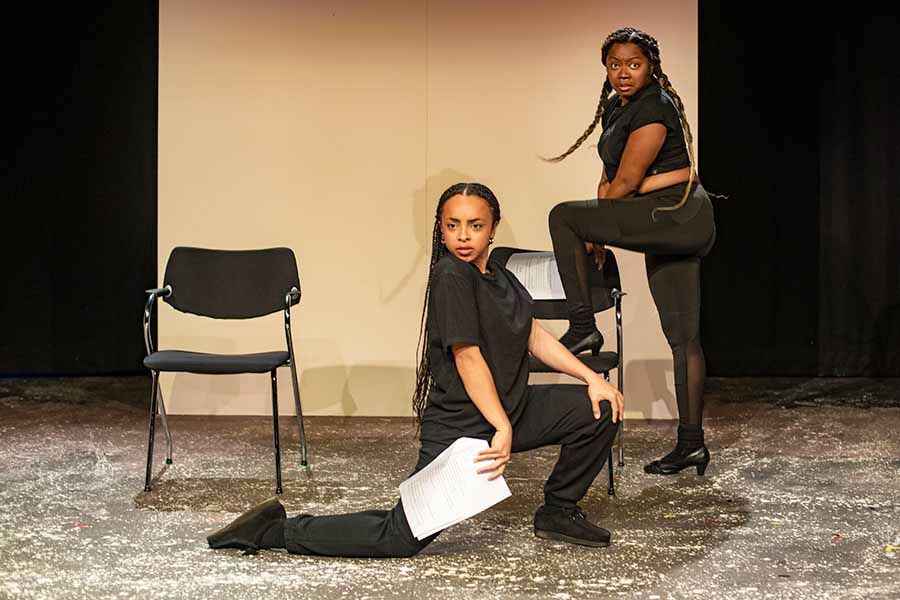
Next up was Nicki Takes a Breath, both written and directed by Sara Amanda. This takes place during auditions for a 'ghetto' reinterpretation of Ibsen’s A Doll’s House of which Nicole and Adenike played by Saffron Dey and Keia Johnson respectively, are aspirants. The play is a critique and satire on the industry's surface attempts at diversity, where authenticity is sacrificed for stereotype, and adequately expresses the choices which actors like Nicole and Adenike must make in pursuit of career success. Both actors make a convincing comedic performance.
 III.
III.
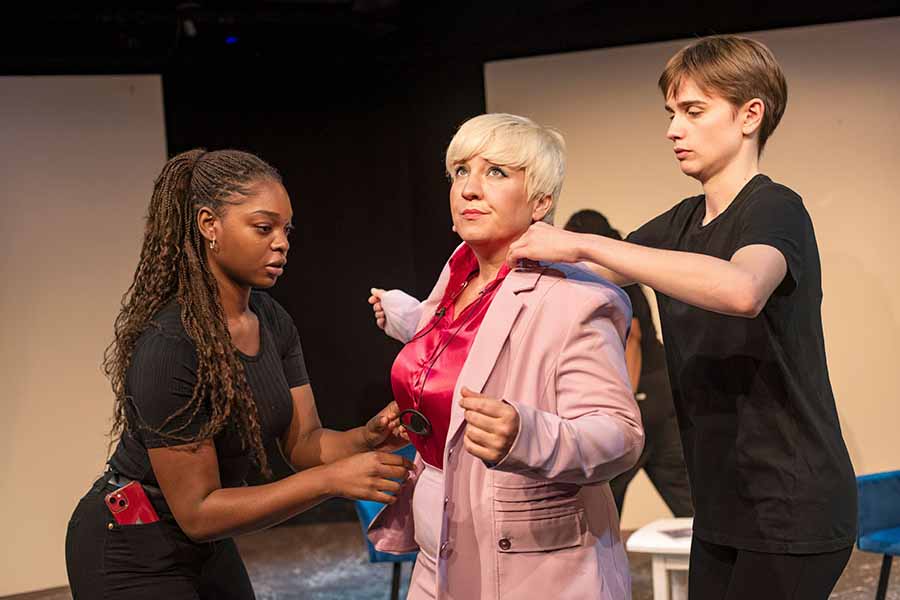
The third play, Eileen Gbagbo’s In Conversation was another directed by Landé Belo, with assistant direction from Nick Edwards. This takes place in a TV studio, in which economics expert Dr. Tiwa Sowunmi-Smith played by Zainab Ottun is interviewed by show host Lauren Morris played by Louise Paton. Paton is convincing in her portrayal of an all-too-familar condescending, shit-stirring host, whose attempts to bait her guest leave the interview devoid of any real meaning for its audience. Ottun’s performance is likewise spot on as a guest balancing anger toward micro-aggressions from the host, and providing a considered response to callers’ questions. With the deliberate mispronunciation of Tiwa’s name kicking start their interaction, prospects of conviviality seemed henceforth doomed. Like Changing Rays, the antagonist is female, highlighting the play’s attempt to showcase the unique experience of Black women in Britain.
 IV.
IV.
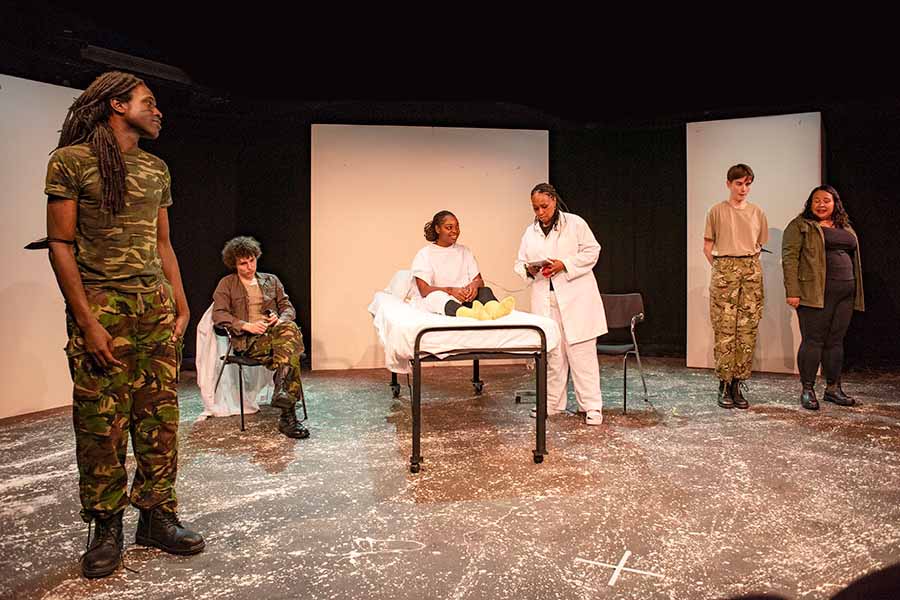
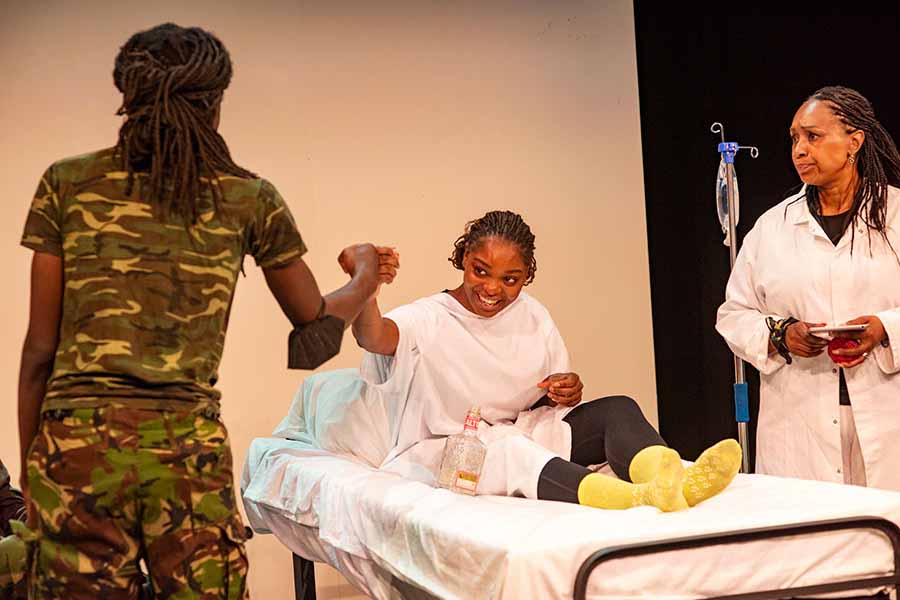
Written by Rukiat Ashawe and directed by Landé Belo with assistant direction from Eileen Gbagbo, 2037: The Burden was undoubtedly the most different of the plays. It features a movement’s struggle for survival in a militaristic virus-stricken Britain. The action takes place in a medical room, where the movement’s leader, Fin, played by Kahlea Allison is being treated. In front of her inebriated comrades Fin learns that she is pregnant. She must weigh up self-interest against the group's survival and expectations they have set upon her; all present make clear their opinions of what she should do. Allison gives an emotional and versatile performance, and elicits real sympathy from the audience from the way in which she expresses the impact her comrades' judgments. Moments of genuine tension arise with interventions from Clive and Brave, played by Dominic Reed and Manuela Lazić respectively. The defensive intervention of Clive adds real presence to the scene especially. The recurring beep of a heart monitor, the camouflage costume and the simple sterile set work in compliment to the tense exchanges on stage. Whilst the acting was powerful, the play’s denouement felt a little lost.
 V.
V.
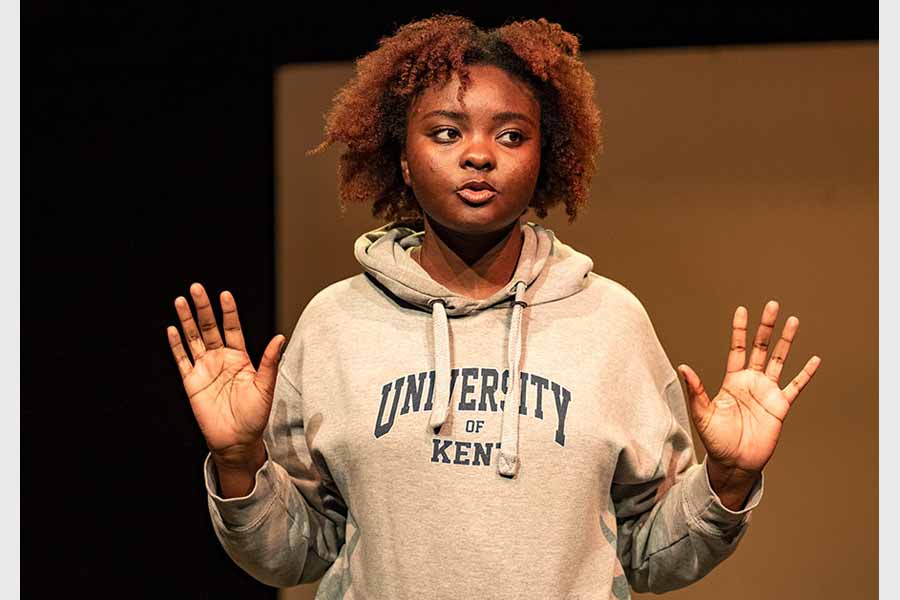
The last play, Mary Queen of Thots, is a one-woman monologue written by Katrina Smith-Jackson and directed by Beverly Andrews. Megan-Madaleine Freeman plays Mary, who takes us on a journey though her experiences with online dating. The play makes a good effort at balancing humour with a deeper social commentary on modern relationships and the double standards with which projections are made on certain cohorts of society. According to the Urban Dictionary, THOT stands for "That Hoe Over There", a term the play explores through Mary’s series of sexual encounters. Freeman delivers an energetic performance full of strong and ranging characterisation, particularly when weighing up the poor but well-meaning advice she receives from her flawed, but loveable friend. The acting is juxtaposed with a back drop projection of Dali’s Christ on A Cross, a painting I know well as a former neighbour of the Kelvingrove Gallery, where it resides. Presumably the choice of set designer Bolu Dairo, the painting shows the ultimate sacrifice at its most visceral angle. This comparison seemed a little over-the-top, but perhaps the reference was lost on me.
 Ain't I A Woman? is a needed and noteworthy theatrical experience with powerful moments of acting and thought-provoking subject matter. Though the writing was often a little too overtly didactic for my liking, the plays' topics were necessary ones and performed with diligence by the ensemble.
Photography by Pau Ros
|


