


Macbeth
by William Shakespeare
Directed by Eileen Mullen
May 18th - 25th, 2002
The Tower Theatre Company performing at the Tower Theatre, Canonbury





Cast List
First Witch : Barbara Mathews
Second Witch : Alison Hopwood
Third Witch : Alison Liney
Duncan, King of Scotland : John Cornwell
Malcolm, Duncan's son : Martin Jackson
Donalbain, Duncan's son : Peter Miller
A Bloody Sergeant : Terry Mathews
Macduff : Bob Bradick
Ross : Michael Allaway
Angus : James Easey
Menteith : Simon Bullock
Caithness : Christopher Armstrong
Lennox : Alexander Gordon Wood
Macbeth : Ian Chaplain
Banquo : Douglas McDiarmid
Lady Macbeth : Alison Hopwood
Seyton : Douglas McDiarmid
Fleance, Banquo's son : Peter Miller
First Murderer : Simon Bullock
Second Murderer : Christopher Armstrong
Third Murderer : James Easey
Porter : Terry Mathews
Old Man : Simon Bullock
Lady Macduff : Kathryn McKnight
Young Macduff : Matthew Sellar
Gentlewoman : Barbara Mathews
Doctor : Chris Holmes
Old Siward : Terry Mathews
Young Siward : Peter Miller
Production Team
Director : Eileen Mullen
Set Designer : Jo Staples
Lighting Designer : Stephen Ley
Costume Designer : Dinah Irvine
Sound Designer : Laurence Tuerk
Fight Arranger : Steve Starr
Stage Manager : Dinah Irvine
ASMs : Claire Rice, Lesley Scarth, Jean Carr
Lighting operator : Meg Meagher
Sound operator : Lisa Kelvey
Wardrobe : Phillis Spencer, Roanne Insley, Kay Perversi
Set construction : Terry Mathews, Keith Syrett, Robert Myer, Tom Tillery, Gail Willis, John Sole, John Morton, Roger Beaumont,
Rebecca Vincent, Steven Hyndman, Hilary Allan & members of cast and crew
In-house review by David Reynolds
David Reynolds has been a Tower member for 10 years and has been involved with comedy and theatre for somewhat longer in performing, writing and directing guises.
Every schoolboy knows that Macbeth is the shortest of Shakespeare's great
tragedies (put in some Tower members' jargon, it's a three-pint play rather
than a one-pint). Yet, perhaps it seems shorter than it actually is because the
sheer action of the prophecies, the machinations, the murders and the eventual
overthrow of the protagonist, drives the audience through the work at a remarkable pace.
Eileen Mullen's production felt instinctively in tune with this central dynamic
and the ensemble scenes were all full of vigour. A major element to this energy
was the fact that the lines were, on the whole, well spoken and timed and it was
all readily understandable notwithstanding the antiquity of the language.
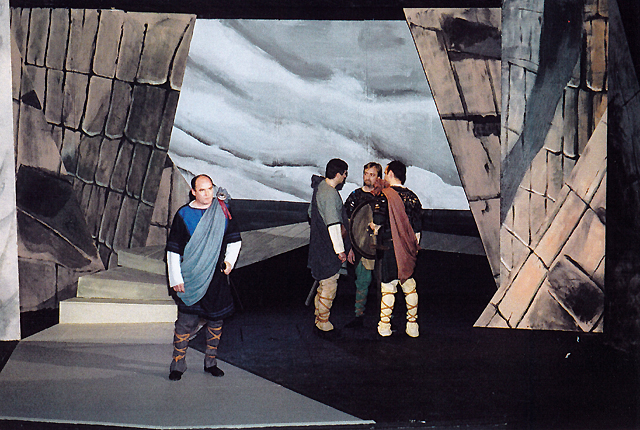
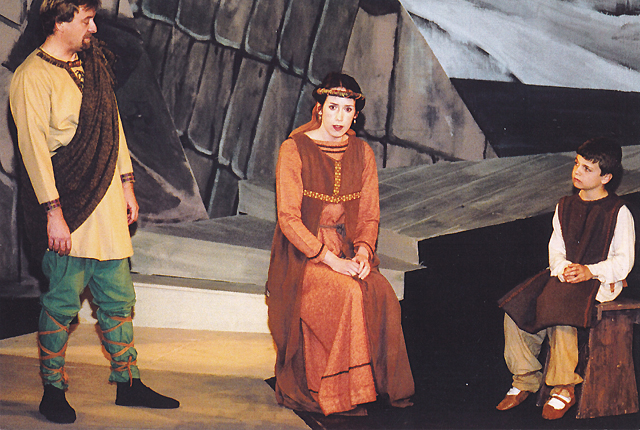
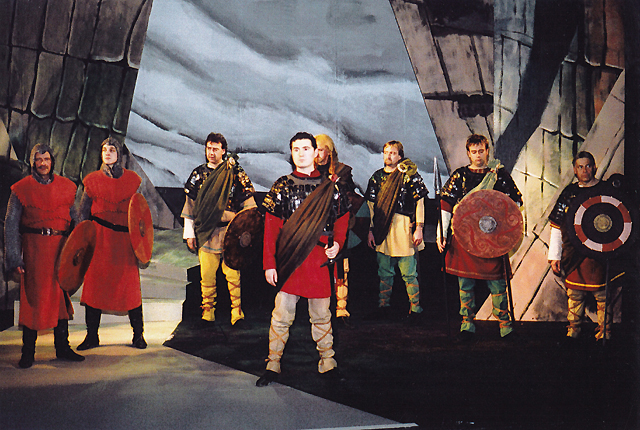
Another reason was Jo Staples' striking set with its cold, almost geometric angles,
projections and levels - able to conjure the hard stone of dimly-lit castles as
well as to encompass the exterior settings. The opening and closing tableaux were
particularly effective with this staging, I thought.
The production also scored very highly with this reviewer in terms of lighting
design which was handled, as ever, under the safe and intelligent pair of hands
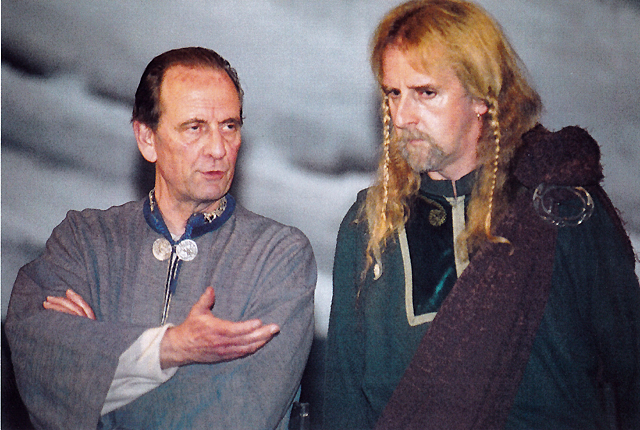
that is Stephen Ley and also in terms of costumes (Dinah Irvine, wearing a
different Tower hat than usual, so to speak).
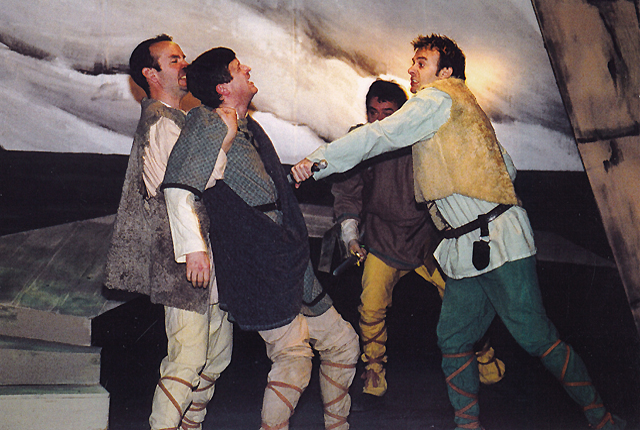
You could argue that the violence of the fight/battle scenes was no more than
mildly suggested in Ms. Mullen's interpretation. While I do not think you have to
mount a gore-fest to make the point, my own preference vvould have been for a
stronger effect in this respect.
Whilst on this topic, I did notice that Macduff produced Macbeth's head at the
end wrapped in a handy head-cloth bag. While I have no problem with that, you
have to agree that it is amazing just how easy it is to pick up sach bags on a
medieval battlefield. I rather imagine Eric Idle selling them for one groat a time!
Whilst the witches scenes were quite well acted and the Hecate accretions to the
script wisely omitted, I think that these days, in an ideal world (which is not
necessarly a beautiful Parisian garden in June sunlight in this context) a
director would want to avoid using physical props for the various apparitions
that emerge from the cauldron. He/she might also want to re-create the
procession of the kings and Banquo's ghost by some other method rather than having
several actors simply promenade (precariously in some cases) across the back of
the stage, but that is a more debatable argument in truth.
No, my real concern with Eileen Mullen's production was with the two leads or,
to be more precise, with the basic technique of one and the casting of the other.
Some theatre folk refer to the play as "The Macbeths" and it is true that Lady M
seems to feature in the piece as prominently as her husband. Certainly, their
relationship is one of theatre's most fascinating alliances and you have to get
both parts right to make the play work properly.
Ian Chaplain, as Macbeth, unfortunately adopted a very mannered demeanour for
most of the time which, while it never sank below the threshhold of farce,
did come close to it at times, in my opinlon. On the other hand, he is a
good actor with a commanding presence and I do not think this mistake fatally
wounded the production, as it could so easily have done. He otherwise spoke
the lines and soliloquies well and the role was well within his range.
To do Macbeth, you need the physical toughness and mental courage of the
successful warrior combined with the tragic weakness of a man too easily
influenced by flattery, supernatural prediction and the lust for power.
When he did let the "mask" drop occasionally, a massive chink of light seemed
to illuminate the performance.
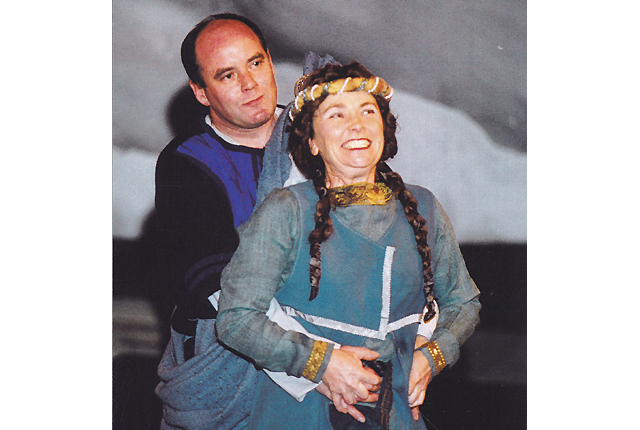
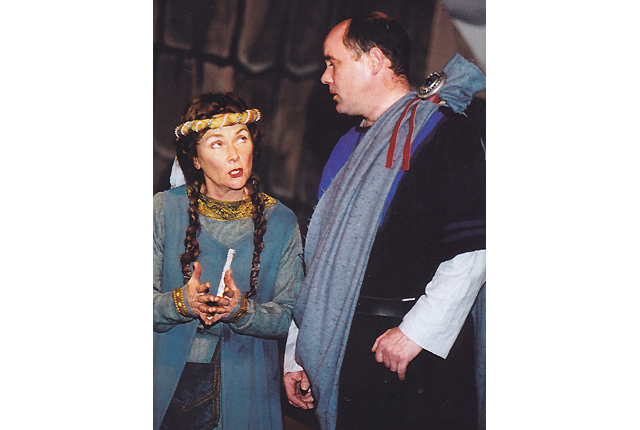
In contrast, I felt Alison Hopwood was simply miscast as Lady Macbeth. Although
she is an excellent actress, she is simply too far away in real life from the
cold malevolence of the part. However, that said, there was plenty of light and
shade in the portrayal and, again, she spoke the lines meaningfully throughout
in what was still a creditable performance.
The supporting roles were quite well delivered although some better than others.
I must say, I thought that as Duncan, John Cornwell was more genial than saintly:
after all, the murder of the king is an act of sacrilege and has to be felt as
such by the audience. Nonetheless, it was a solid contribution, as was that of
Bob Bradick as Macduff although he was more effective when using the lower
register of his voice than when using the upper.
Moving on, the part of Banquo is difficult since he is not an extrovert character.
Douglas McDiarmid was suitably serious but needed to work this more towards of
sense of gravitas and, because he did not, I felt Banquo's importance to the
story became somewhat lost along the way.
Martin Jackson gave us a good and vigorous Malcolm and Terry Mathews was quite
excellent both as the Porter and Old Siward. Other parts were all handled with
commitment and clarity of speech, but, all the same, I did sometimes feel that
more work could have been done on character in some cases (the murderers, for
example, could have been nastier).
My favourite bits in the second half were the Lady M sleepwalking episode where
Alison Hopwood plus Chris Holmes as the doctor and Barbara Mathews as the
Gentlewoman all combined most effectively, and also the Lady Macduff/Young
Macduff scene. The latter scene is such a strange and difficult one to bring off
but it was played perfectly by Kathryn McKnight and Matthew Sellar.
Although I had some serious reservations about the show, it is possible that
some of these drawbacks were necessitated by the impending difficult task of
presenting what is, undeniably, one of the darkest pieces of theatre ever written
in the Bois de Boulogne in broad daylight. In any event, the production held my
attention throughout and seeing it only served to remind me just how magnificent
a play Macbeth is and how deep was William Shakespeare's genius. Oh yes,
and it's brilliant to watch!
Macbeth
by William Shakespeare |
|
|
May 18th - 25th, 2002 |
The Tower Theatre Company performing at the Tower Theatre, Canonbury |
|
Cast List
|
Production Team
|
In-house review by David Reynolds
David Reynolds has been a Tower member for 10 years and has been involved with comedy and theatre for somewhat longer in performing, writing and directing guises.
Every schoolboy knows that Macbeth is the shortest of Shakespeare's great
tragedies (put in some Tower members' jargon, it's a three-pint play rather
than a one-pint). Yet, perhaps it seems shorter than it actually is because the
sheer action of the prophecies, the machinations, the murders and the eventual
overthrow of the protagonist, drives the audience through the work at a remarkable pace.
Eileen Mullen's production felt instinctively in tune with this central dynamic
and the ensemble scenes were all full of vigour. A major element to this energy
was the fact that the lines were, on the whole, well spoken and timed and it was
all readily understandable notwithstanding the antiquity of the language.
Another reason was Jo Staples' striking set with its cold, almost geometric angles,
projections and levels - able to conjure the hard stone of dimly-lit castles as
well as to encompass the exterior settings. The opening and closing tableaux were
particularly effective with this staging, I thought.
The production also scored very highly with this reviewer in terms of lighting
design which was handled, as ever, under the safe and intelligent pair of hands
that is Stephen Ley and also in terms of costumes (Dinah Irvine, wearing a
different Tower hat than usual, so to speak).
You could argue that the violence of the fight/battle scenes was no more than
mildly suggested in Ms. Mullen's interpretation. While I do not think you have to
mount a gore-fest to make the point, my own preference vvould have been for a
stronger effect in this respect.
Whilst on this topic, I did notice that Macduff produced Macbeth's head at the
end wrapped in a handy head-cloth bag. While I have no problem with that, you
have to agree that it is amazing just how easy it is to pick up sach bags on a
medieval battlefield. I rather imagine Eric Idle selling them for one groat a time!
Whilst the witches scenes were quite well acted and the Hecate accretions to the
script wisely omitted, I think that these days, in an ideal world (which is not
necessarly a beautiful Parisian garden in June sunlight in this context) a
director would want to avoid using physical props for the various apparitions
that emerge from the cauldron. He/she might also want to re-create the
procession of the kings and Banquo's ghost by some other method rather than having
several actors simply promenade (precariously in some cases) across the back of
the stage, but that is a more debatable argument in truth.
No, my real concern with Eileen Mullen's production was with the two leads or,
to be more precise, with the basic technique of one and the casting of the other.
Some theatre folk refer to the play as "The Macbeths" and it is true that Lady M
seems to feature in the piece as prominently as her husband. Certainly, their
relationship is one of theatre's most fascinating alliances and you have to get
both parts right to make the play work properly.
Ian Chaplain, as Macbeth, unfortunately adopted a very mannered demeanour for
most of the time which, while it never sank below the threshhold of farce,
did come close to it at times, in my opinlon. On the other hand, he is a
good actor with a commanding presence and I do not think this mistake fatally
wounded the production, as it could so easily have done. He otherwise spoke
the lines and soliloquies well and the role was well within his range.
To do Macbeth, you need the physical toughness and mental courage of the
successful warrior combined with the tragic weakness of a man too easily
influenced by flattery, supernatural prediction and the lust for power.
When he did let the "mask" drop occasionally, a massive chink of light seemed
to illuminate the performance.
In contrast, I felt Alison Hopwood was simply miscast as Lady Macbeth. Although
she is an excellent actress, she is simply too far away in real life from the
cold malevolence of the part. However, that said, there was plenty of light and
shade in the portrayal and, again, she spoke the lines meaningfully throughout
in what was still a creditable performance.
The supporting roles were quite well delivered although some better than others.
I must say, I thought that as Duncan, John Cornwell was more genial than saintly:
after all, the murder of the king is an act of sacrilege and has to be felt as
such by the audience. Nonetheless, it was a solid contribution, as was that of
Bob Bradick as Macduff although he was more effective when using the lower
register of his voice than when using the upper.
Moving on, the part of Banquo is difficult since he is not an extrovert character.
Douglas McDiarmid was suitably serious but needed to work this more towards of
sense of gravitas and, because he did not, I felt Banquo's importance to the
story became somewhat lost along the way.
Martin Jackson gave us a good and vigorous Malcolm and Terry Mathews was quite
excellent both as the Porter and Old Siward. Other parts were all handled with
commitment and clarity of speech, but, all the same, I did sometimes feel that
more work could have been done on character in some cases (the murderers, for
example, could have been nastier).
My favourite bits in the second half were the Lady M sleepwalking episode where
Alison Hopwood plus Chris Holmes as the doctor and Barbara Mathews as the
Gentlewoman all combined most effectively, and also the Lady Macduff/Young
Macduff scene. The latter scene is such a strange and difficult one to bring off
but it was played perfectly by Kathryn McKnight and Matthew Sellar.
Although I had some serious reservations about the show, it is possible that
some of these drawbacks were necessitated by the impending difficult task of
presenting what is, undeniably, one of the darkest pieces of theatre ever written
in the Bois de Boulogne in broad daylight. In any event, the production held my
attention throughout and seeing it only served to remind me just how magnificent
a play Macbeth is and how deep was William Shakespeare's genius. Oh yes,
and it's brilliant to watch!