


Table Manners
by Alan Ayckbourn
Directed by Nigel Martin
June 15th - 22nd, 2002
The Tower Theatre Company performing at the Tower Theatre, Canonbury


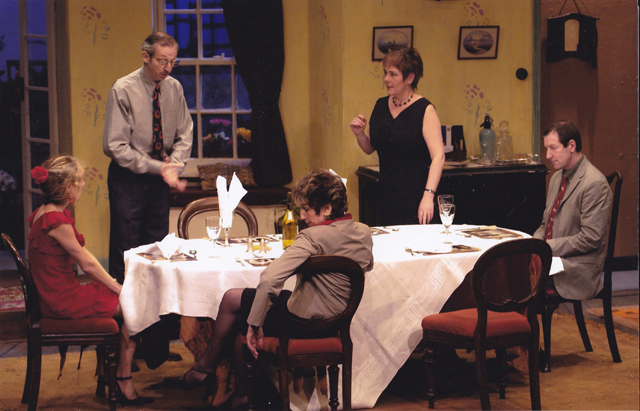


This is believed to be the first Tower show shot with a digital camera : the improvement in quality is very noticable!
Cast List
Annie : Jill Fear
Sarah : Colette Dockery
Tom : Allan Hart
Reg : Peter Westbury
Norman : Stuart Denman
Ruth : Despina Sellar
Production Team
Director : Nigel Martin
Set Designer : Roger Beaumont
Lighting Designer : Hillary Allen
Stage managers : Moira McSperrin, Lesley Scarth
ASMs : Meg Meagher, Zizi Sulkin, Rosalind Moore, Louise Dockery, Tom Bailey,
Margaret Ley
Properties : Celia Reynolds
Costumes : Members of the cast
Lighting operators : Rachel Hindley,
Rachel Lacaille
Sound operataor : Karan Bhagat
Sound tape : Simon Humphries
Set construction : Rober Myer, Keith Syrett,
John Feather, Phillip Ley, Jude Chalk, Meryl Griffiths, Steven Hyndman & members of the cast and crew
In-house review by Colin Smith
Before retirement, Colin Smith was a BBC Radio producer specialising
in poetry and drama for schools.
For BBC Worldwide he edited and co-produced Noël Coward - An Autobiography, which
was voted Best Production in the Spoken Words Awards 2001.
Table Manners, dating from 1973, is perhaps better known as one part of
The Norman Conquests :
three related plays capable of being performed simultaneously. The situation common to all
three is a family weekend during which Norman, a shiftless librarian, propositions his two
sisters-in-law Annie and Sarah, and his wife Ruth. Alan Ayckbourn thus sets himself even more
problems of construction than is usual in farce, but acquits himself triumphantly:
"We could only afford six characters, only two stage entrances .. and the actor I
had to play Norman couldn't join us for the first few days of the season - which
necessitated him making a late entrance to facilitate rehearsals". He went on to
report "I found myself grappling with the triplet sisters all with very different
personalities. Climaxes, comic ones naturally, seemed to abound everywhere. Table Manners
was the most robust and, as it proved on stage, the most overtly funny".
However, there's a trap for the unwary. Ayckbourn adds that eighty per cent of the
productions he has seen of his plays have always been far too boisterous. "That's
the British idea of having a good time". Table Manners calls for six
resourceful actors to play themes and variations on the individual and shared grievances,
stresses and neuroses of the three couples; and happily the Tower team was well matched
- and understated, for added enjoyment. Sarah and Reg, Ruth and Norman, Annie and Tom.
Colette Dockery's Sarah, trying to impose order on the domestic chaos in Annie's house,
climaxed with her frustrated seating arrangements at the table. She clashed energetically
with Reg (Peter Westbury): oblivious to her demands, he projected a kind of superior jokiness
and buoyancy. Tom, the vaguest of vets, provokes maddened responses all round, even from
usually patient Annie whose own untroubled chaos is the despair of her sisters. Allan Hart
as this lost dog also gave the essentially well-meaning strain in his character's make-up;
and Jill Fear's Annie was thoroughly rounded out with self-conscious laughs and gauche
body language.
For the third couple, Despina Sellar as Ruth swept through yet another variation on marital
indifference, expecting only the worst from everyone but particularly from her errant husband
Norman. Blithely predatory, there remained an element of mystery in his make-up seems intended
by the author:
is Norman a calculating Casanova or merely an immature dreamer? Stuart Denman
maintained this ambiguity; despite his self-justifying monologue, his motives remain somewhat
opaque, which may be why he finally finds a degree of success with all three women. They deny
anything of the sort, but as Ayckbourn says of Sarah: "She fancies Norman more than any of
them, so she's fighting herself, and she's also fighting the sins of her sisters in law".
It's been suggested that in the original production Norman was exposed as man drive not so
much by lust as by the constant itch for attention; a point equally evident in Nigel Martin's
stylish production. This was enhanced by Roger Beaumont's idiosyncratic setting, its shabby,
outmoded pastel décor and threadbare upholstery attuned to the chaos of live-in daughter Annie.
"My plays are best appreciated", says Ayckbourn, "if you've had at least one unhappy marriage
or at least one unhappy relationship, otherwise you won't know what's going on". Without
presuming to hazard our audiences' domestic experiences they obviously found the kind of
illumination he goes on to describe: "The best part of my work is not the clapping, it's
the feeling that at the end of the evening you have given the most wonderful party and
those who came are feeling better. I don't know, but they are sort of unified into a
whole and that is marvellous".
Table Manners
by Alan Ayckbourn |
|
|
June 15th - 22nd, 2002 |
The Tower Theatre Company performing at the Tower Theatre, Canonbury |
|
Cast List
|
Production Team
|
In-house review by Colin Smith
Before retirement, Colin Smith was a BBC Radio producer specialising
in poetry and drama for schools.
For BBC Worldwide he edited and co-produced Noël Coward - An Autobiography, which
was voted Best Production in the Spoken Words Awards 2001.
Table Manners, dating from 1973, is perhaps better known as one part of
The Norman Conquests :
three related plays capable of being performed simultaneously. The situation common to all
three is a family weekend during which Norman, a shiftless librarian, propositions his two
sisters-in-law Annie and Sarah, and his wife Ruth. Alan Ayckbourn thus sets himself even more
problems of construction than is usual in farce, but acquits himself triumphantly:
"We could only afford six characters, only two stage entrances .. and the actor I
had to play Norman couldn't join us for the first few days of the season - which
necessitated him making a late entrance to facilitate rehearsals". He went on to
report "I found myself grappling with the triplet sisters all with very different
personalities. Climaxes, comic ones naturally, seemed to abound everywhere. Table Manners
was the most robust and, as it proved on stage, the most overtly funny".
However, there's a trap for the unwary. Ayckbourn adds that eighty per cent of the
productions he has seen of his plays have always been far too boisterous. "That's
the British idea of having a good time". Table Manners calls for six
resourceful actors to play themes and variations on the individual and shared grievances,
stresses and neuroses of the three couples; and happily the Tower team was well matched
- and understated, for added enjoyment. Sarah and Reg, Ruth and Norman, Annie and Tom.
Colette Dockery's Sarah, trying to impose order on the domestic chaos in Annie's house,
climaxed with her frustrated seating arrangements at the table. She clashed energetically
with Reg (Peter Westbury): oblivious to her demands, he projected a kind of superior jokiness
and buoyancy. Tom, the vaguest of vets, provokes maddened responses all round, even from
usually patient Annie whose own untroubled chaos is the despair of her sisters. Allan Hart
as this lost dog also gave the essentially well-meaning strain in his character's make-up;
and Jill Fear's Annie was thoroughly rounded out with self-conscious laughs and gauche
body language.
For the third couple, Despina Sellar as Ruth swept through yet another variation on marital
indifference, expecting only the worst from everyone but particularly from her errant husband
Norman. Blithely predatory, there remained an element of mystery in his make-up seems intended
by the author:
is Norman a calculating Casanova or merely an immature dreamer? Stuart Denman
maintained this ambiguity; despite his self-justifying monologue, his motives remain somewhat
opaque, which may be why he finally finds a degree of success with all three women. They deny
anything of the sort, but as Ayckbourn says of Sarah: "She fancies Norman more than any of
them, so she's fighting herself, and she's also fighting the sins of her sisters in law".
It's been suggested that in the original production Norman was exposed as man drive not so
much by lust as by the constant itch for attention; a point equally evident in Nigel Martin's
stylish production. This was enhanced by Roger Beaumont's idiosyncratic setting, its shabby,
outmoded pastel décor and threadbare upholstery attuned to the chaos of live-in daughter Annie.
"My plays are best appreciated", says Ayckbourn, "if you've had at least one unhappy marriage
or at least one unhappy relationship, otherwise you won't know what's going on". Without
presuming to hazard our audiences' domestic experiences they obviously found the kind of
illumination he goes on to describe: "The best part of my work is not the clapping, it's
the feeling that at the end of the evening you have given the most wonderful party and
those who came are feeling better. I don't know, but they are sort of unified into a
whole and that is marvellous".