


Eclipse
by Simon Armitage
Directed by Peter Miller and Amanda Morgan
September 11th - 14th, 2002
The Tower Youth Theatre performing at the Tower Theatre, Canonbury
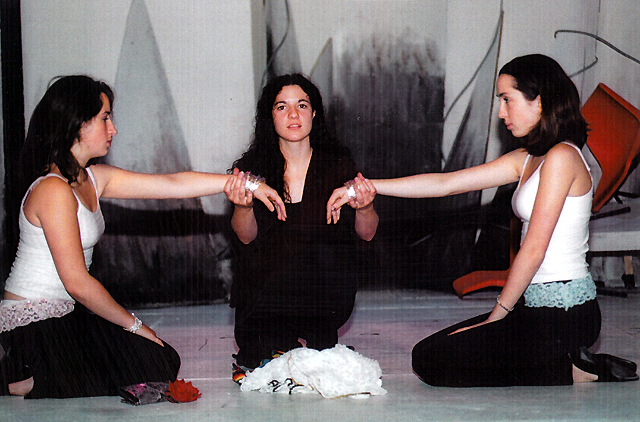
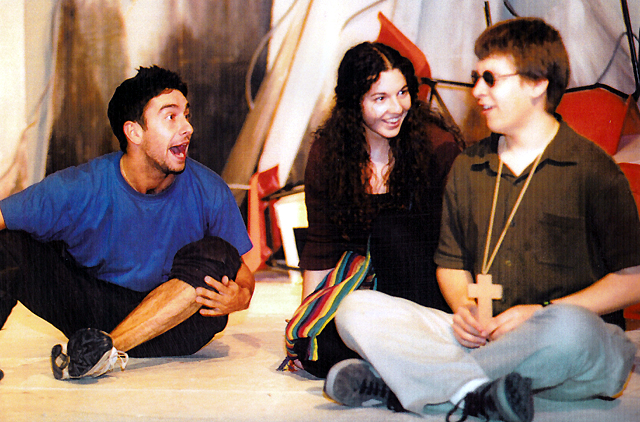
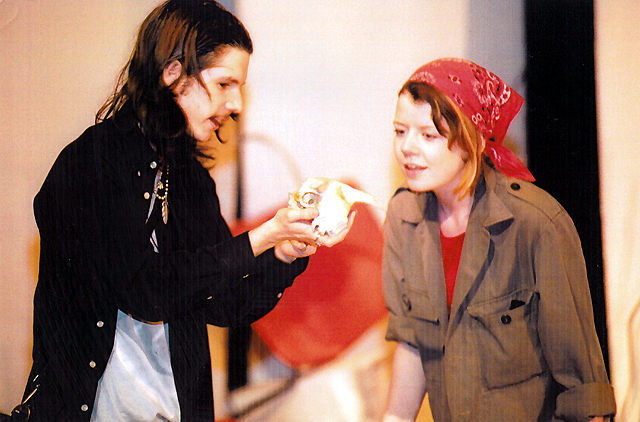
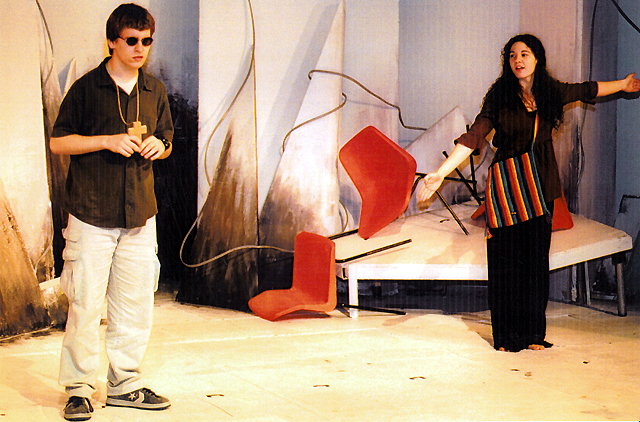
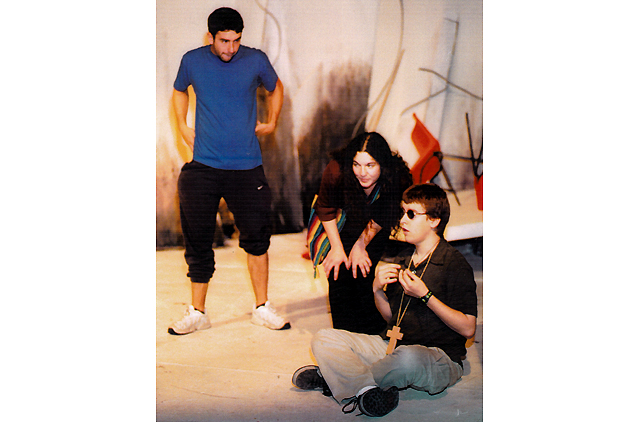
Cast List
Klondike : Henry Briant
Tulip : Caroline Leonard
Polly : Amy Scarth
Jane : Hannah Gollancz
Midnight : Thomas Lee-Smith
Glue Boy : John Glynn
Lucy Lime : Kathy Berketa
Production Team
Directors : Peter Miller and Amanda Morgan
Set Designer : Amy Pope
Lighting Designer : Katherine Davidson
Stage Manager : Robert Irvine
ASMs : Anna Anderson, Juliette Daigre
Sound operators : Tom Cattermole, Ana Castro
Lighting operators : Juliette Daigre, Katherine Davidson
Wardrobe : Holly Smith
Set construction : Chi Ugoala, Laurence Tuerk, Keith Syrett, Nick Insley, Ian Chaplain, Michael Allaway, Gail Willis, Hilary Allan, Adrian Hull, Jeremy Walker & members of the cast & crew
In-house review by Richard Pedersen
Richard Pedersen is a Tower member of thirteen years standing who first trod
the boards at the age of nine.
To my shame, I must confess that Eclipse, Peter Miller and
Amanda Morgan's production of the play by Simon Armitage, was the first
Tower Youth Theatre production which I had attended. I was, in fact, in
the throes of buying my ticket when our esteemed Editor asked me if I
would write the review. Not to be outdone, I saw the play twice on
successive nights.
I wish that I could say that I enjoyed it
unreservedly, but I'm afraid I can't, and most of the problem lies
with the play. It is obvious from the programme notes that Philip
Armitage is a poet first and foremost, and this came through loud
and clear during the performance. He was almost self-consciously
poetic in his writing which I felt was to the detriment of the drama.
The writing hindered the actors who were unable to be wholly convincing
characters, hamstrung as they were by pages of (dare I say it) pretentious
semi-verse.
The plot, in a nutshell, is that six young people known
mostly by their assumed monikers - Klondike, Tulip, Midnight, Glue Boy
and the identical twins Polly and Jane - are in Cornwall with their
families for the 1999 eclipse. On the beach they meet the strange
figure of Lucy Lime who changes their perceptions and then disappears
as mysteriously as she appeared. Echoes of The Passing of the Third
Floor Back"?
My nagging question throughout the production was
"how old are these people supposed to be?". I sense that the play was
really written for rather younger actors than the company of the
Tower Youth Theatre (whose ages ranged from 18 to 22). There was a
childishness about much of the action and dialogue which ill-fitted
the apparently streetwise people on stage. And yet unlike in Blue
Remembered Hills I wasn't aware that the company was attempting
to play younger than they were. As a result of this a lot of the
play didn't ring true - parents up on the cliff top, Klondike
collecting pretty curios in a bag, Glue Boy sniffing glue from a
plastic bag.
Despite the handicap of the script, however, the
directors gave us a lively and engaging production which never lost
its vitality and was ingenious in its use of the stage. There were
no below-par performances either from the seven actors, who all
deserve a creditable mention. I particularly liked the performance
of John Glynn as Paul Bond known as Glue Boy, basically out of his
skull on solvents for the duration of the action (whatever did his
parents up on the cliff think?). He loped around wide-eyed, never
other than fully engaged in the action, equally impressive when
listening for the non-existent boat and seagulls as when he held
centre stage. His diction was faultless in a role where much of
the dialogue was gobbledegook.
Similarly impressive was Thomas
Lee-Smith in the equally difficult role of Martin Blackwood or
Midnight. Midnight because of the fact that he has been totally
blind since the age of ten. There were instances where I felt that
the actor could see more than he was supposed to but in general
the pretence of the lack of sight was well kept up. But what was
the author playing at sending him off for ice creams? I was
confused how a sightless young man is supposed to scale a cliff
face and then return to the selfsame spot on the beach with two
ice creams (and no white stick). The sight of the melting ice creams
was nevertheless the funniest moment in the play.
Less successful
among the men was, I felt, Henry Briant as Klondike (we never learn
his real name). His hair and moustache belied an intensely childlike
character while his new-age mouthings became increasingly annoying.
I thought that the actor could have improved on his vocal delivery -
at one and the same time it sounded a little too elocuted, while
it had an unfortunate habit of fading away at the end of sentences.
The three girls in the group of friends - Caroline Leonard as Tulip,
Amy Scarth as Polly and Hannah Gollancz as Jane - were all highly
competent actors and gave us believable performances, if their
characters were a bit thinly-drawn. Tulip is described in the script
as a tomboy, but I'm not sure what that means for a woman in her late
teens. The twins, Polly and Jane, looked convincingly younger and they
made a good effort at looking identical. I did think that a bit more
make-up would not have gone amiss so that they could have looked even
more doll-like. Their vocal delivery was spot-on, particularly when
speaking in unison.
I honestly didn't know what to make of the
outsider to the group; Lucy Lime as played by Kathy Berketa.
Initially, like the other six I found her annoying, and since we knew
from the start that she was going to end up disappeared if not dead,
I was waiting for someone to take the plunge and get rid of her. The
others, however seemed to take a shine to the woman but I regret that
I never did. Not to detract from Ms Berketa's competent performance -
she was limited like the others by a weird script. The tale of standing
naked on a canal bank having been thrown in by three men (I can almost
understand why) was little more than cringe-evoking.
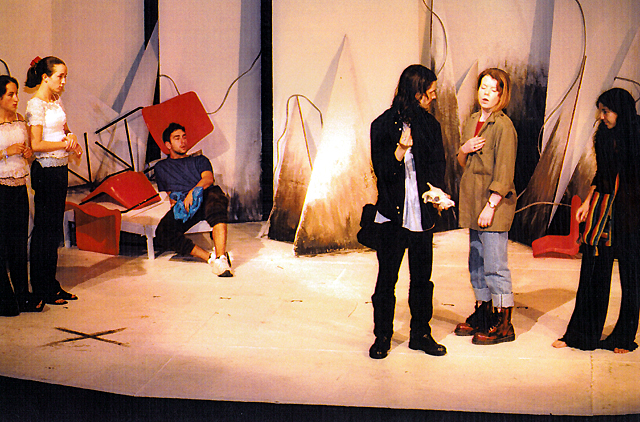
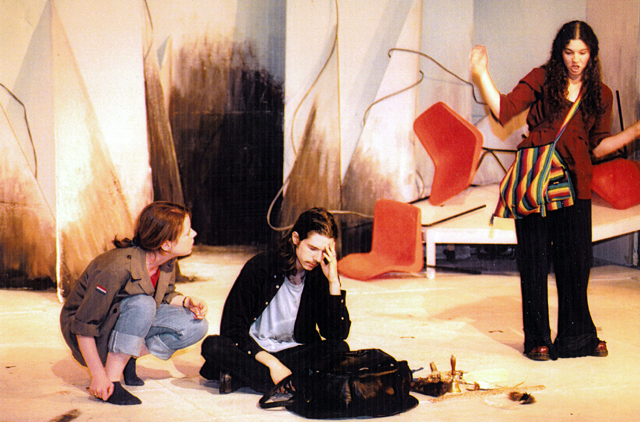
The set design
by Amy Pope was effective and striking, with entrances and exits
well-concealed. I was less convinced by the electric fence, a key part
of the action, which looked just too symbolic. The incidental music
was nicely appropriate to the play. I understand moreover, that all
the design and technical back-up was provided by members of the Youth
Theatre themselves, without the unwanted interference of older Tower
members. Congratulations to you all.
It is one of my lifelong
regrets that the Teesside Youth Theatre was founded the year I fled
the parental nest so I never participated in it. I sincerely hope
that all those involved in the production will become full-time Tower
members, although I note from the programme that most of the cast
have their sights set on further horizons. Without wanting to sound
patronising - good luck to you all and thank you for two enjoyable evenings.
Eclipse
by Simon Armitage |
|
|
September 11th - 14th, 2002 |
The Tower Youth Theatre performing at the Tower Theatre, Canonbury |
|
Cast List
|
Production Team
|
In-house review by Richard Pedersen
Richard Pedersen is a Tower member of thirteen years standing who first trod the boards at the age of nine.
To my shame, I must confess that Eclipse, Peter Miller and
Amanda Morgan's production of the play by Simon Armitage, was the first
Tower Youth Theatre production which I had attended. I was, in fact, in
the throes of buying my ticket when our esteemed Editor asked me if I
would write the review. Not to be outdone, I saw the play twice on
successive nights.
I wish that I could say that I enjoyed it
unreservedly, but I'm afraid I can't, and most of the problem lies
with the play. It is obvious from the programme notes that Philip
Armitage is a poet first and foremost, and this came through loud
and clear during the performance. He was almost self-consciously
poetic in his writing which I felt was to the detriment of the drama.
The writing hindered the actors who were unable to be wholly convincing
characters, hamstrung as they were by pages of (dare I say it) pretentious
semi-verse.
The plot, in a nutshell, is that six young people known
mostly by their assumed monikers - Klondike, Tulip, Midnight, Glue Boy
and the identical twins Polly and Jane - are in Cornwall with their
families for the 1999 eclipse. On the beach they meet the strange
figure of Lucy Lime who changes their perceptions and then disappears
as mysteriously as she appeared. Echoes of The Passing of the Third
Floor Back"?
My nagging question throughout the production was
"how old are these people supposed to be?". I sense that the play was
really written for rather younger actors than the company of the
Tower Youth Theatre (whose ages ranged from 18 to 22). There was a
childishness about much of the action and dialogue which ill-fitted
the apparently streetwise people on stage. And yet unlike in Blue
Remembered Hills I wasn't aware that the company was attempting
to play younger than they were. As a result of this a lot of the
play didn't ring true - parents up on the cliff top, Klondike
collecting pretty curios in a bag, Glue Boy sniffing glue from a
plastic bag.
Despite the handicap of the script, however, the
directors gave us a lively and engaging production which never lost
its vitality and was ingenious in its use of the stage. There were
no below-par performances either from the seven actors, who all
deserve a creditable mention. I particularly liked the performance
of John Glynn as Paul Bond known as Glue Boy, basically out of his
skull on solvents for the duration of the action (whatever did his
parents up on the cliff think?). He loped around wide-eyed, never
other than fully engaged in the action, equally impressive when
listening for the non-existent boat and seagulls as when he held
centre stage. His diction was faultless in a role where much of
the dialogue was gobbledegook.
Similarly impressive was Thomas
Lee-Smith in the equally difficult role of Martin Blackwood or
Midnight. Midnight because of the fact that he has been totally
blind since the age of ten. There were instances where I felt that
the actor could see more than he was supposed to but in general
the pretence of the lack of sight was well kept up. But what was
the author playing at sending him off for ice creams? I was
confused how a sightless young man is supposed to scale a cliff
face and then return to the selfsame spot on the beach with two
ice creams (and no white stick). The sight of the melting ice creams
was nevertheless the funniest moment in the play.
Less successful
among the men was, I felt, Henry Briant as Klondike (we never learn
his real name). His hair and moustache belied an intensely childlike
character while his new-age mouthings became increasingly annoying.
I thought that the actor could have improved on his vocal delivery -
at one and the same time it sounded a little too elocuted, while
it had an unfortunate habit of fading away at the end of sentences.
The three girls in the group of friends - Caroline Leonard as Tulip,
Amy Scarth as Polly and Hannah Gollancz as Jane - were all highly
competent actors and gave us believable performances, if their
characters were a bit thinly-drawn. Tulip is described in the script
as a tomboy, but I'm not sure what that means for a woman in her late
teens. The twins, Polly and Jane, looked convincingly younger and they
made a good effort at looking identical. I did think that a bit more
make-up would not have gone amiss so that they could have looked even
more doll-like. Their vocal delivery was spot-on, particularly when
speaking in unison.
I honestly didn't know what to make of the
outsider to the group; Lucy Lime as played by Kathy Berketa.
Initially, like the other six I found her annoying, and since we knew
from the start that she was going to end up disappeared if not dead,
I was waiting for someone to take the plunge and get rid of her. The
others, however seemed to take a shine to the woman but I regret that
I never did. Not to detract from Ms Berketa's competent performance -
she was limited like the others by a weird script. The tale of standing
naked on a canal bank having been thrown in by three men (I can almost
understand why) was little more than cringe-evoking.
The set design
by Amy Pope was effective and striking, with entrances and exits
well-concealed. I was less convinced by the electric fence, a key part
of the action, which looked just too symbolic. The incidental music
was nicely appropriate to the play. I understand moreover, that all
the design and technical back-up was provided by members of the Youth
Theatre themselves, without the unwanted interference of older Tower
members. Congratulations to you all.
It is one of my lifelong
regrets that the Teesside Youth Theatre was founded the year I fled
the parental nest so I never participated in it. I sincerely hope
that all those involved in the production will become full-time Tower
members, although I note from the programme that most of the cast
have their sights set on further horizons. Without wanting to sound
patronising - good luck to you all and thank you for two enjoyable evenings.